Basic agent loop
| Section | Agent patterns |
| Time to complete | ~15 min |
| Model | muse-spark-1.3 |
| Harness | OpenCode |
Summary
This recipe shows how OpenCode runs the agent loop with Muse Spark to fix failing tests in a Python sample project. The core rule of the loop: each turn the model reads context, reasons, calls one tool, reads the result, and decides whether the task is done or needs another turn. pytest is the oracle for whether a fix worked.
When does the CLI enter an agent loop?
- Completing the task takes more than one turn against the codebase.
- It has to act, read the result, then decide the next step from what it observed.
- An objective check (a test or a build) defines "done", so it can tell when to stop.
It stays out of the loop when none of these hold: a one-shot edit with nothing to observe is a single completion, and a fixed sequence that never branches is just a script. The loop is what the CLI falls into whenever "done" depends on what each step reveals.
The agent loop contract
Each turn the model gathers context, reasons, calls one tool, reads the result, and decides whether the task is done or another turn is needed. Guards bound the loop so a stuck run cannot continue without limit.
The loop ends in one of five ways: the task is complete, the iteration cap is reached, the token budget is spent, the model reports it cannot solve the task, or the user cancels. Only the first is success. The guards, the termination conditions, and the trace format are shown in the worked examples below.
How OpenCode implements the pattern
OpenCode runs this loop and maps each step onto its own tools:
| Loop step | OpenCode mechanism |
|---|---|
| RECEIVE | the prompt you pass to opencode or opencode run |
| READ | the Read and Glob tools |
| THINK | the reasoning Muse Spark emits before a tool call, shown when reasoning: true |
| ACT | the Edit tool or a bash command |
| OBSERVE | the tool result fed back to the model |
| EVALUATE | the loop continues until Muse Spark returns a final message or a guard fires |
Configure OpenCode for Muse Spark
Install OpenCode if you haven't already (npm i -g opencode-ai).
Step 1 — Connect the Meta provider
OpenCode has built-in support for the Meta provider.
First, get an API key from the Model API dashboard under API keys → Create API key.
Launch OpenCode, then run the connect command:
A searchable "Connect provider" list appears. Type to filter, select Meta, and confirm. Then paste the key from the dashboard into the "API key" prompt.
Step 2 — Select Muse Spark 1.1
After connecting the provider, choose Muse Spark 1.1. The status bar should read Muse Spark 1.1 · Meta, confirming it's live.
Try it on the sample project
The agent-loop-target/(opens in new tab) sample project is a small Python project. It starts green except for five planted bugs, each with one failing test that defines "done", so pytest is the oracle for whether a fix worked. Confirm the starting state:
bash
The bugs climb in difficulty:
| # | Module | Category |
|---|---|---|
| 1 | pagination.py | off-by-one in a list operation |
| 2 | grades.py | wrong comparison operator |
| 3 | normalize.py | missing edge case |
| 4 | weather.py | incorrect API response parsing |
| 5 | async_counter.py | race condition in async code |
A full Go mirror of the same five bugs lives in agent-loop-target/go-example/. Each worked example below shows the prompt, a screenshot, the trace, and the diff.
Fix the off-by-one
Give OpenCode the failing test and let the loop run. From inside the sample project:
bash
The run reads the test, finds and reads the implementation, edits the file, runs the test, sees 5 passed, and stops.
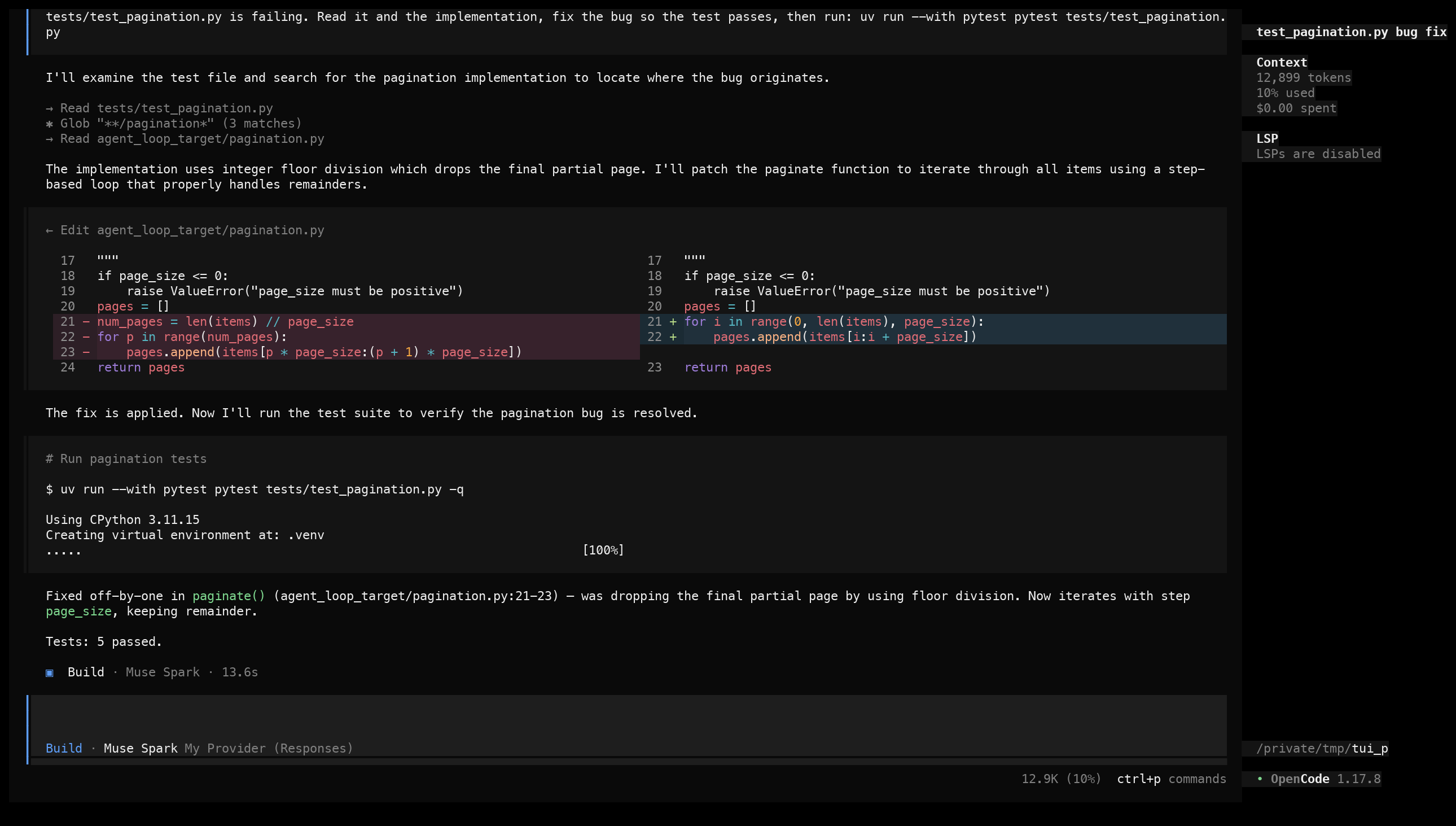
The same run reads as one block per turn:
Turn 1 reads the test, turns 2 and 3 find and read the implementation, turn 4 reasons and edits, and the final bash turn runs the test, sees 5 passed, and ends the loop. The change Muse Spark made:
diff
Fix the async race
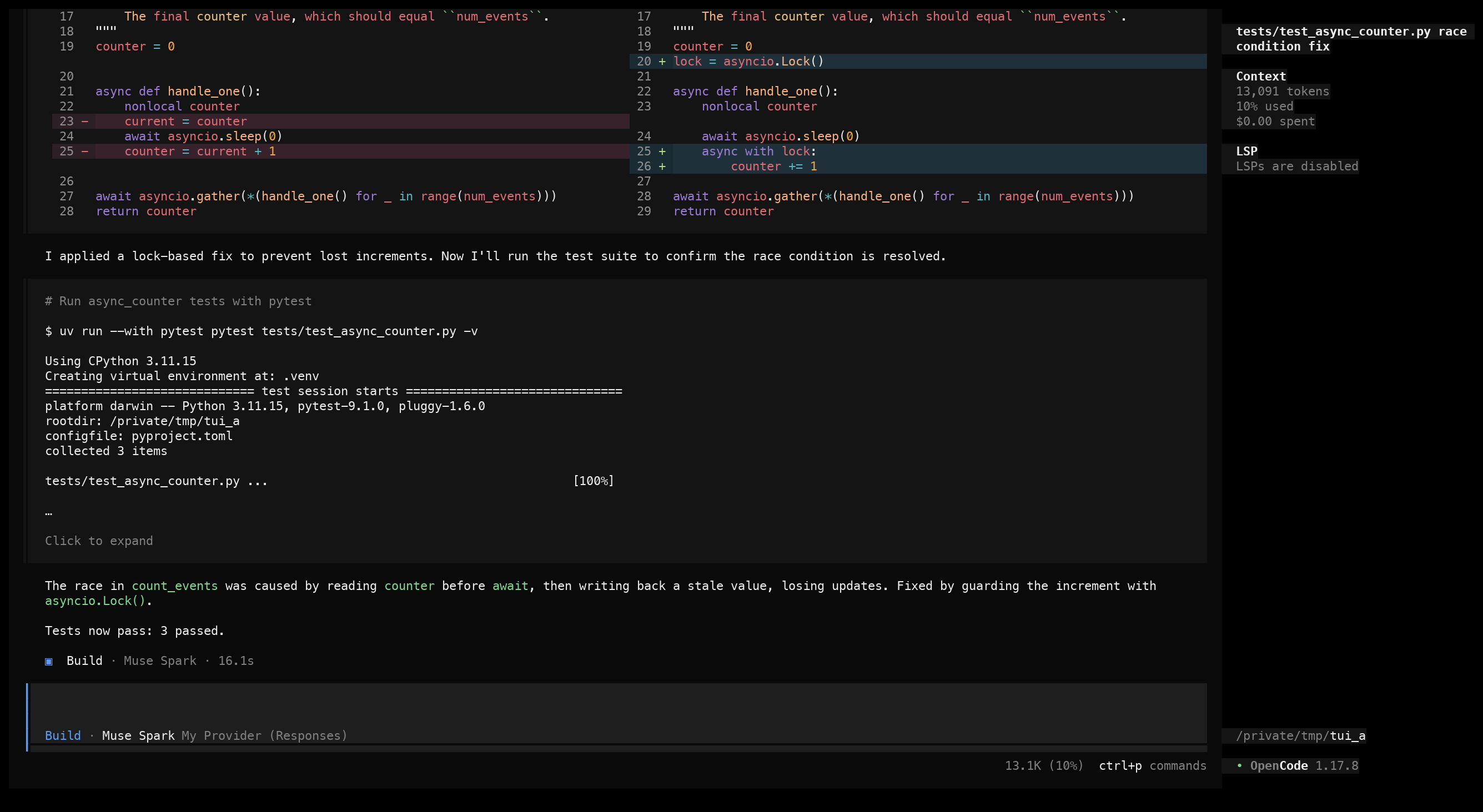
The async race fails deterministically: concurrent increments lose updates and the count comes out too low. Muse Spark fixes it by guarding the read-modify-write.
bash
Validate every run
pytest is the oracle: run the loop, then run the test suite to score it. Running all five bugs with the same one-line prompt gives these results (turns and tokens are reconstructed from the model-call log):
| bug | category | fixed | turns | mode |
|---|---|---|---|---|
bug1_pagination | off-by-one in a list operation | yes | 6 | headless (opencode run) |
bug2_grades | wrong comparison operator | yes | 6 | headless (opencode run) |
bug3_normalize | missing edge case | yes | 5 | tui (headless Responses hung) |
bug4_weather | incorrect API response parsing | yes | 7 | headless (opencode run) |
bug5_async_counter | race condition in async code | yes | 14 | headless (opencode run) |
Result: 5/5 fixed, average 7.6 turns (max 14), 0 doom loops. The target was at least 4 of 5 fixed in under 15 turns each.
OpenCode profile
The loop enforces one contract: one tool per turn, an observed result, and an objective oracle for "done". How that looks in OpenCode:
- OpenCode:
opencode -m meta/muse-spark-1.3. Reasoning shows as a dimmedThoughtblock; tools render asRead,Edit, andbashlines.
Common failure modes
Permission prompts for actions outside the project
OpenCode guards actions that reach outside the project directory: reading or writing files elsewhere on the filesystem, or running shell commands. When the model attempts one, OpenCode asks for permission. In the interactive TUI you approve or deny each prompt. In headless opencode run there is no one to approve, so the guarded action is auto-rejected and the run continues without it, or stalls if it depended on that action. A run that tries to read the filesystem root is rejected like this:
Expect these prompts whenever a task touches paths or commands outside the project. Keep prompts scoped to the project, run interactively and approve when an action genuinely needs broader access, or set OpenCode's permission config to allow the paths you expect.
Doom loops
If the model edits, runs the test, sees the same failure, and repeats the same edit, stuck detection should catch it: hash (tool_name, args) and stop after the same call repeats three times.