Goal tracking
| Section | Muse Code |
| Time to complete | ~20 min |
| Model | muse-spark |
| Harness | Muse Code (the muse CLI) |
Summary
This recipe shows how Muse Code keeps an agent on a multi-step task until the task is done. You pin the objective once with /goal, and from then on the harness carries it for you. A status-line indicator tracks it, and a step probe prompts the agent back to the objective when it drifts. A completion audit gates the call that marks the goal done, so the agent runs the acceptance tests before it closes the goal.
Screenshots and captured output are from an actual Muse Code run; because the model is non-deterministic, your results may differ.
When do you pin a goal?
- The task takes several turns and you can name the end state before it starts.
- The finish line is checkable: a command that has to exit clean, or a test suite that has to pass.
- You want the objective to survive across turns without restating it in every prompt.
A one-step task doesn't need a goal. Pin one when the work is long enough that the agent could drift, or finish part of it and stop.
Understand the goal-tracking contract
A goal is a durable objective plus a check on completion. You state it once, the harness keeps it in front of the agent, and the work is measured against it before the goal can close.
| Step | Step description | Muse Code mechanism |
|---|---|---|
| 1. DECLARE | State the objective and its acceptance checks | /goal <objective> stores the objective for the session |
| 2. TRACK | The session shows progress against the objective | A Goal(…) indicator in the status line follows it |
| 3. DRIVE | The objective persists across turns until it is met | Every ~10 model calls that report no progress, a step probe queues a "Continue working toward the active session goal" note |
| 4. VERIFY | The agent proves completion against the current state | That note tells it to check requirement by requirement: files, command output, test results |
| 5. CLOSE | The objective is marked done | The completion audit gates update_goal |
Rule: the goal closes only when every deliverable you asked for is present.
Declare a goal
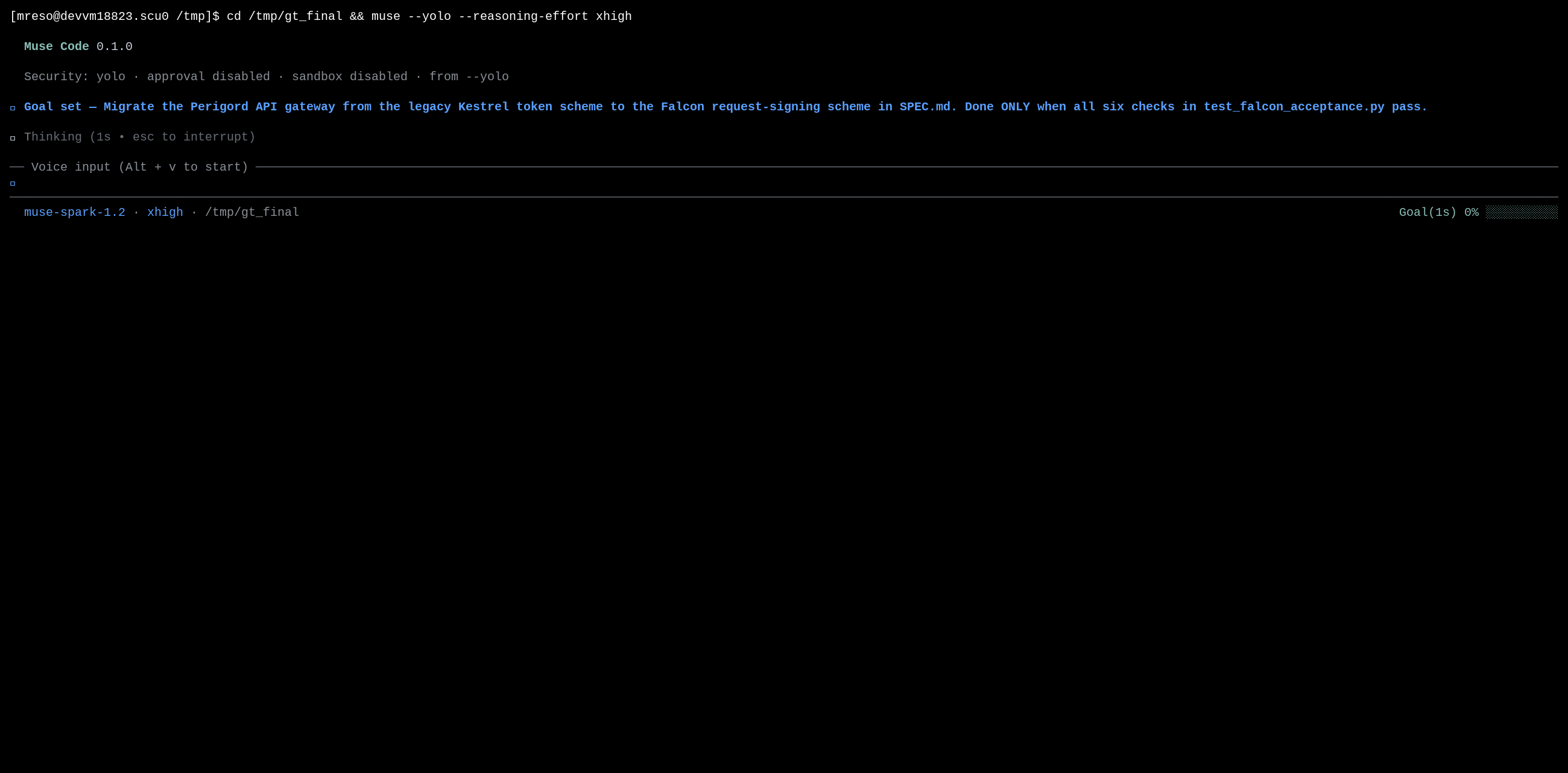
Pin the objective with /goal at the start of the session, before the first prompt that does any work.
bash
Try it on the sample project
The sample is a tiny Python service, perigord_gateway/, that starts with passing unit tests on an invented auth scheme. Today it authenticates every caller with the Kestrel static-token scheme: a shared X-Kestrel-Token header. The task is to migrate it to the Falcon request-signing scheme in SPEC.md: an HMAC-SHA256 signature over the request path, for the registered client peregrine. Kestrel, Falcon, peregrine, and the secret are invented, so a correct answer can only come from the spec.
The finish line is unambiguous. test_falcon_acceptance.py holds six checks, and the goal is done only when every one passes:
bash
Drive the goal to completion
With the goal declared, keep the turn moving and Muse Code carries the objective forward on its own. Each time the step probe splices in the continue-note, the TUI shows it as a one-line goal reminded row. The agent implements the Falcon signature check, updates the gateway, removes the Kestrel token and its shared secret, and runs the acceptance tests.
It marks the goal complete only after the tests pass:
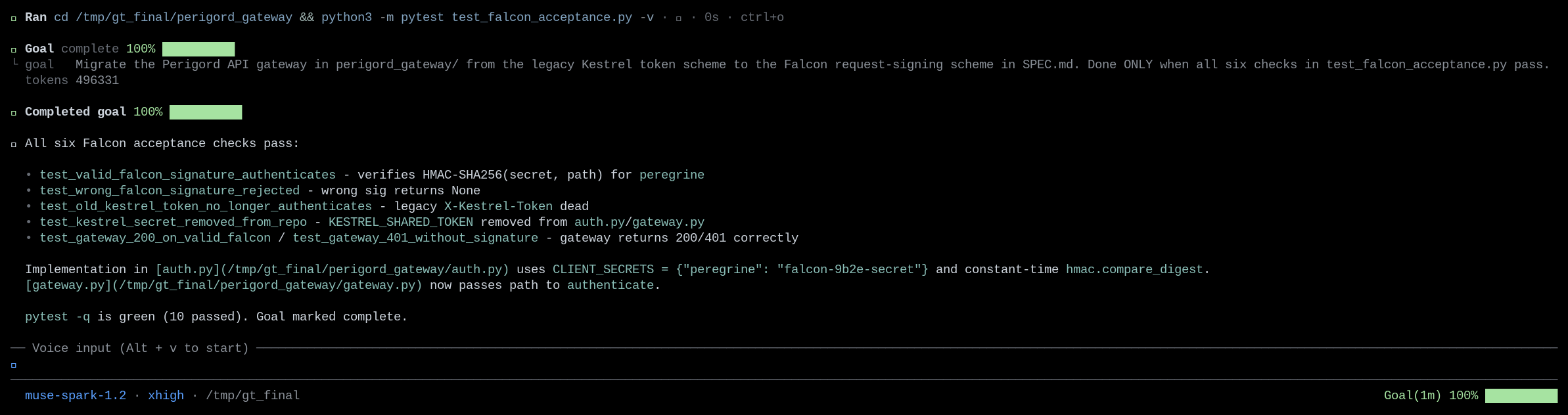
The completion audit is why the agent runs the tests before calling update_goal.
Handle common failures
The agent marks the goal complete too early
update_goal fires with status: "complete" while the acceptance tests are still red.
Recovery: name the oracle in the objective. The sample's goal says "done ONLY when all six checks in test_falcon_acceptance.py pass"; that phrasing points the completion audit at a concrete, checkable target. A goal whose finish line is a command or a test is much harder to close prematurely.
Files in this recipe
License
This recipe is part of the Meta Model API Cookbook and is released under the repository's LICENSE(opens in new tab).