Interleaved reasoning and tool use
| Section | Agent patterns |
| Time to complete | ~15 min |
| Model | muse-spark-1.3 |
| Harness | OpenCode |
Summary
This recipe shows how Muse Spark interleaves reasoning with tool calls in the OpenCode CLI, and how to budget that reasoning. The worked task migrates a callback-style Express API to async/await, where the change has to happen in dependency order. The core rule: the model reasons before each tool call, so the action follows from the reasoning. Reasoning adds latency and cost, so you set how much with the reasoning-effort knob.
When does the CLI use interleaved reasoning?
- The task needs planning across steps, such as a multi-file refactor or a dependency-ordered change.
- Acting in the wrong order would break the build, so it reasons about order before it edits.
For a mechanical, unambiguous change (a rename or a single-line edit), it spends minimal effort. How tight the latency or cost budget is sets the reasoning-effort tier.
The interleaved reasoning contract
An interleaved turn is a stream of typed parts: the model emits reasoning tokens, then a tool call; your harness runs the tool and returns the result; the model reasons again. Across a task the stream is:
The core rule: reason before you act, so each action follows from the reasoning instead of preceding it. Muse Spark reasons by default; you set how much it thinks with the reasoning-effort knob.
How OpenCode implements the pattern
OpenCode is terminal-native, so the loop is visible: it renders reasoning as a dim amber Thought: block, the action as a → tool(args) line, and the tool result inline. The pieces map onto the contract, and the effort knob is the --variant flag:
| Contract | OpenCode |
|---|---|
reasoning part | amber Thought: <ms> block with grey narration |
tool_call | → read / → edit / bash line |
tool_result | rendered inline under the call |
| reasoning effort | the --variant flag (minimal, high, max) |
The run below migrates orderRepository, reasoning about dependency order between edits:
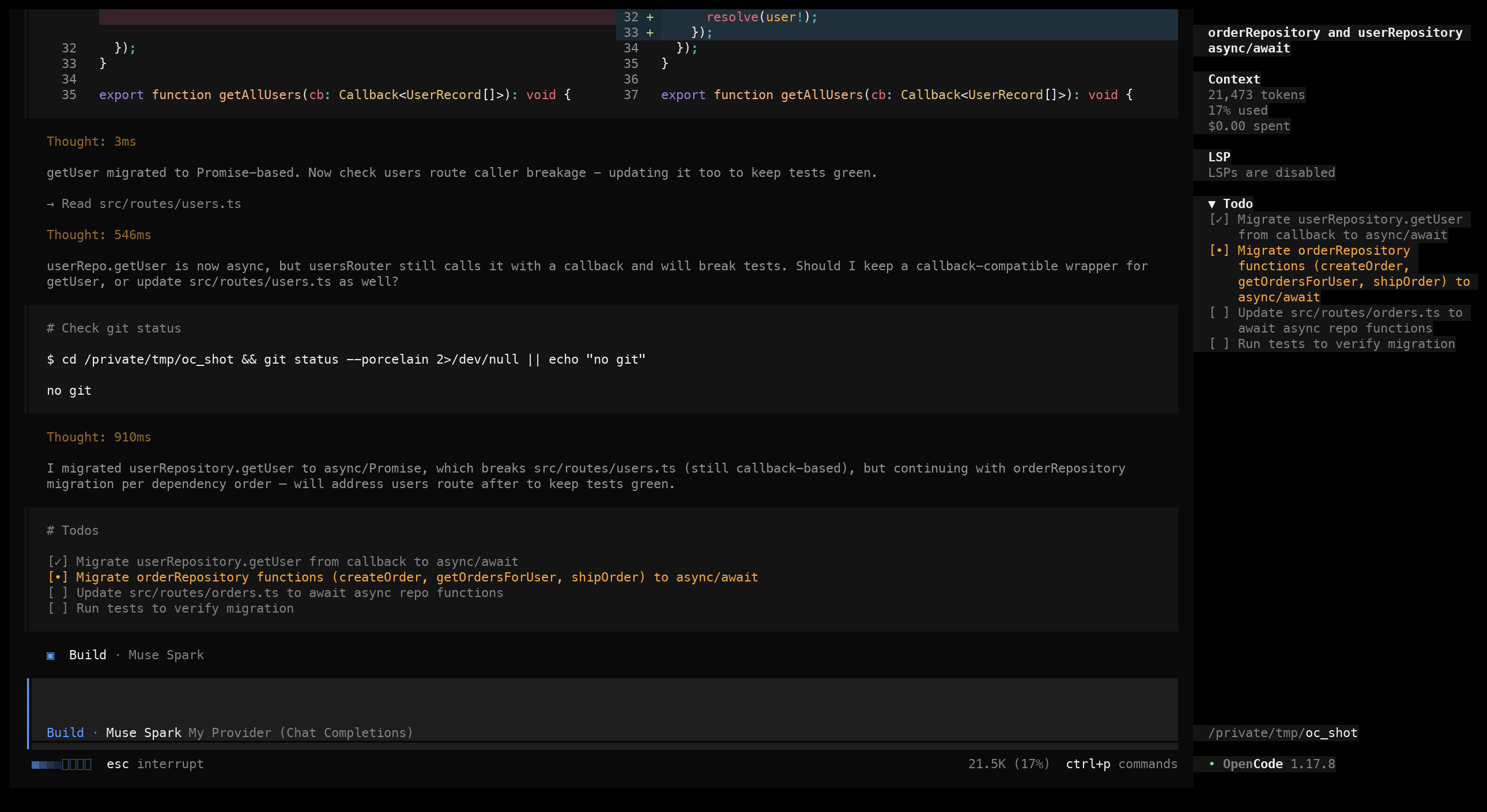
The amber
Thought:blocks carry the reasoning; grey text is the narration;→ Read …lines are tool calls; the right rail is the plan the model maintains as it goes. It notices thatusersRouterstill callsgetUserwith a callback and will break, then reorders its work before editing.
Configure OpenCode for Muse Spark
Install OpenCode if you haven't already (npm i -g opencode-ai).
Step 1 — Connect the Meta provider
OpenCode has built-in support for the Meta provider.
First, get an API key from the Model API dashboard under API keys → Create API key.
Launch OpenCode, then run the connect command:
A searchable "Connect provider" list appears. Type to filter, select Meta, and confirm. Then paste the key from the dashboard into the "API key" prompt.
Step 2 — Select Muse Spark 1.1
After connecting the provider, choose Muse Spark 1.1. The status bar should read Muse Spark 1.1 · Meta, confirming it's live.
Try it on the sample project
The task: migrate the reasoning_target_express_callbacks/(opens in new tab) sample project from error-first callbacks to async/await without changing its behavior. The sample project is a small Express + TypeScript API written in callback style: error-first callbacks, nested callback pyramids, and an EventEmitter notification. It ships green, so the build is how you confirm a migration preserved behavior:
bash
The HTTP tests exercise the API surface, so they stay valid whether the internals are callbacks or async/await. That makes them the right check for a migration: the behavior is fixed, only the style changes.
Five migrations of increasing scope follow. Each runs against a fresh copy of the sample project at --variant high (reasoning on) and is verified with typecheck, jest, and boot-check. Each one shows the prompt, the interleaved trace (thinking then action), and the resulting diff.
1. Leaf function (retry)
Prompt:
In src/lib/callbackUtils.ts, migrate the retry function from error-first callbacks to async/await: it takes an operation returning a Promise and returns a Promise, retrying on rejection up to the given count.
What to notice: No other file imports retry, so the change stays in one file. One read and one edit, with little reasoning needed.
Interleaved trace (thinking then action):
text
Resulting diff:
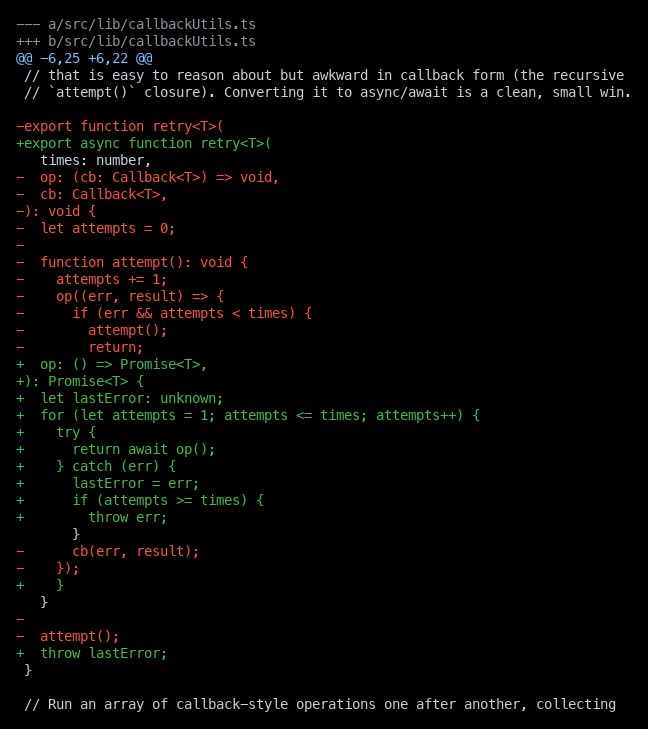
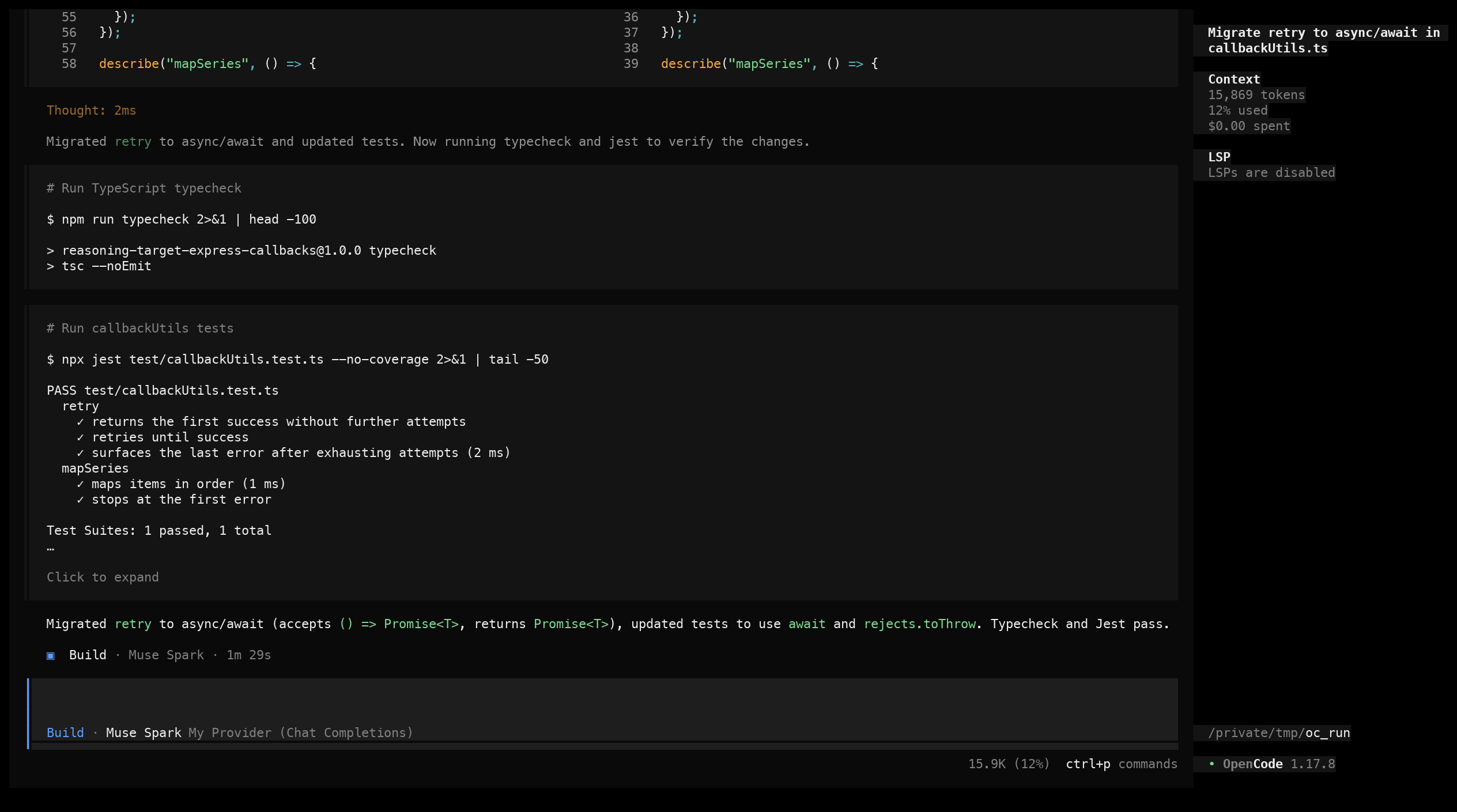
OpenCode finishes the migration and runs the checks itself: the
Thought:block, the diff, and the green summary after typecheck and jest pass.
2. Single file (userRepository)
Prompt:
Migrate src/repositories/userRepository.ts to async/await: every function returns a Promise. Update the callers in src/routes/users.ts so the project still compiles.
What to notice: The model reads the callers before editing, so it knows what the change affects.
Interleaved trace (thinking then action):
text
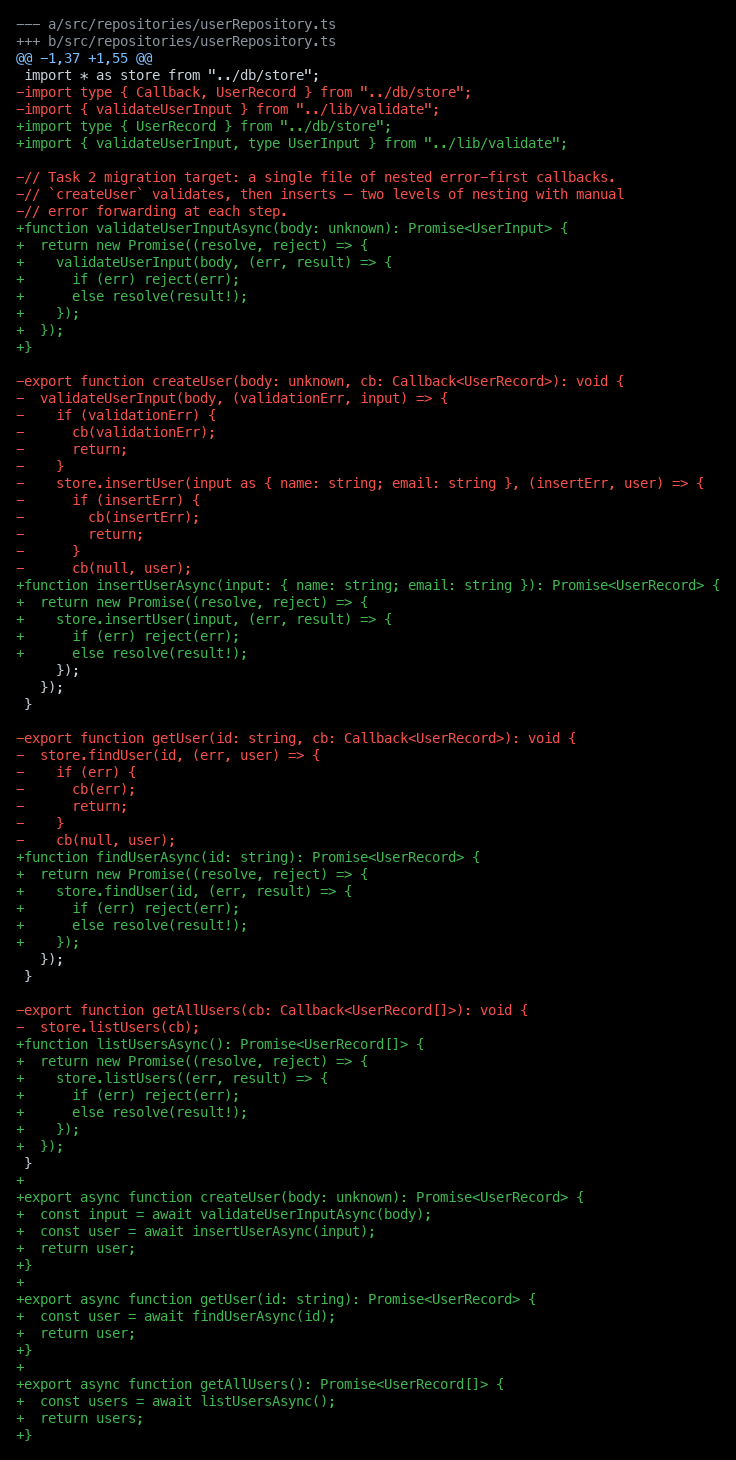
Resulting diff:
3. Cross-file ordering (orderRepository)
Prompt:
Migrate src/repositories/orderRepository.ts and the userRepository.getUser it depends on to async/await, in the correct dependency order, then update src/routes/orders.ts.
What to notice: orderRepository depends on userRepository, so the model converts the dependency first and plans the order before it edits.
Interleaved trace (thinking then action):
text
Resulting diff:
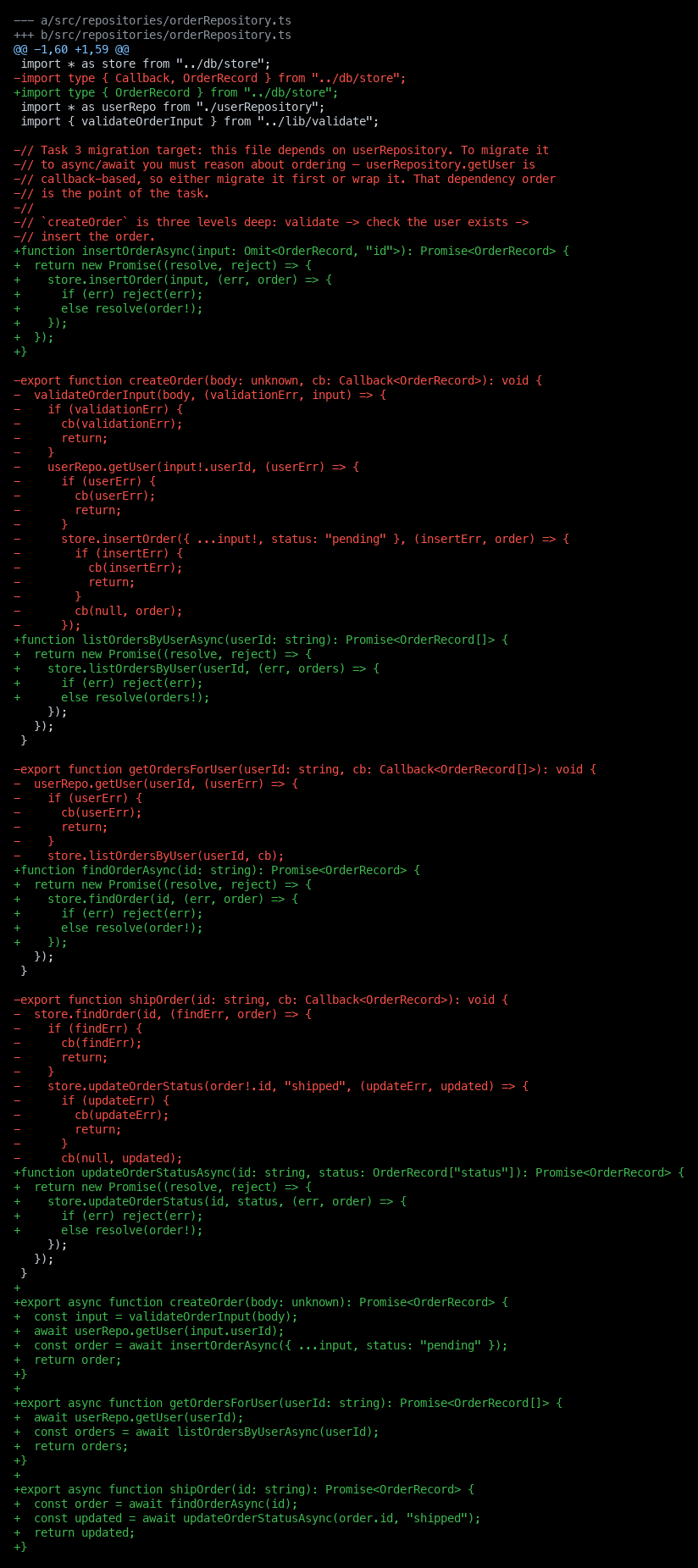
4. Event emitter (onceShipped)
Prompt:
Convert onceShipped in src/services/notificationService.ts from an EventEmitter + callback API to one that returns a Promise (use events.once with an AbortSignal for the timeout). Update the test that awaits it.
What to notice: The model uses events.once and an AbortController in place of the manual listener bookkeeping.
Interleaved trace (thinking then action):
text
Resulting diff:
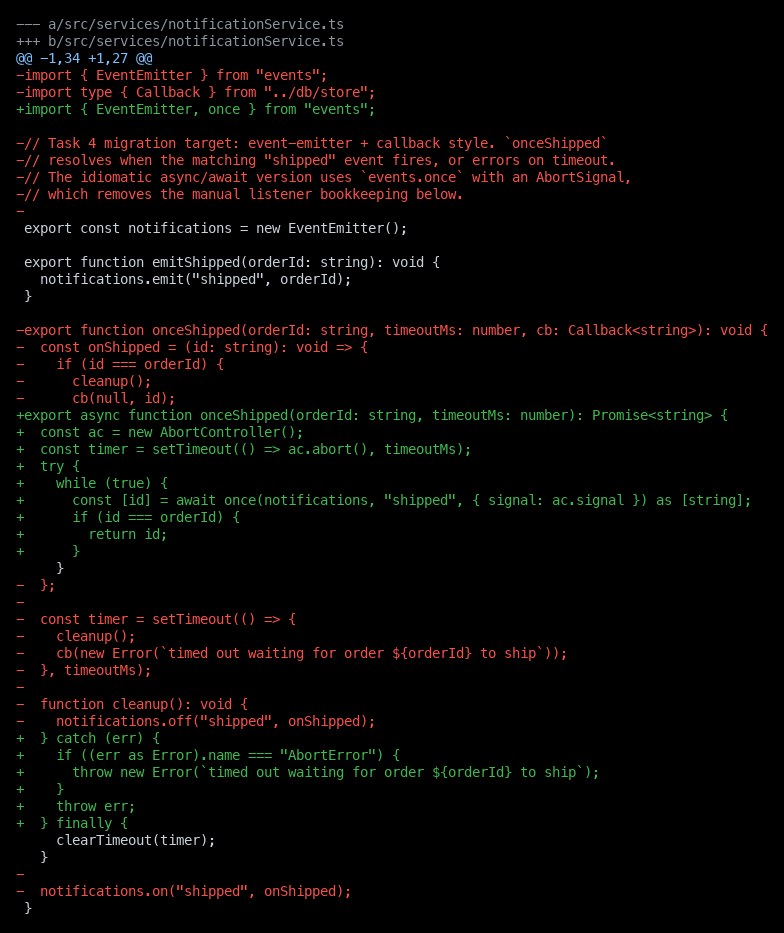
5. Whole module (orders feature)
Prompt:
Migrate the entire orders feature end-to-end to async/await: the order functions in src/db/store.ts, orderRepository, notificationService, and the handlers in src/routes/orders.ts. Leave no callbacks in the orders path.
What to notice: The longest run. The model tracks the dependency chain across seven files and keeps the HTTP tests green.
Interleaved trace (thinking then action):
text
Resulting diff:
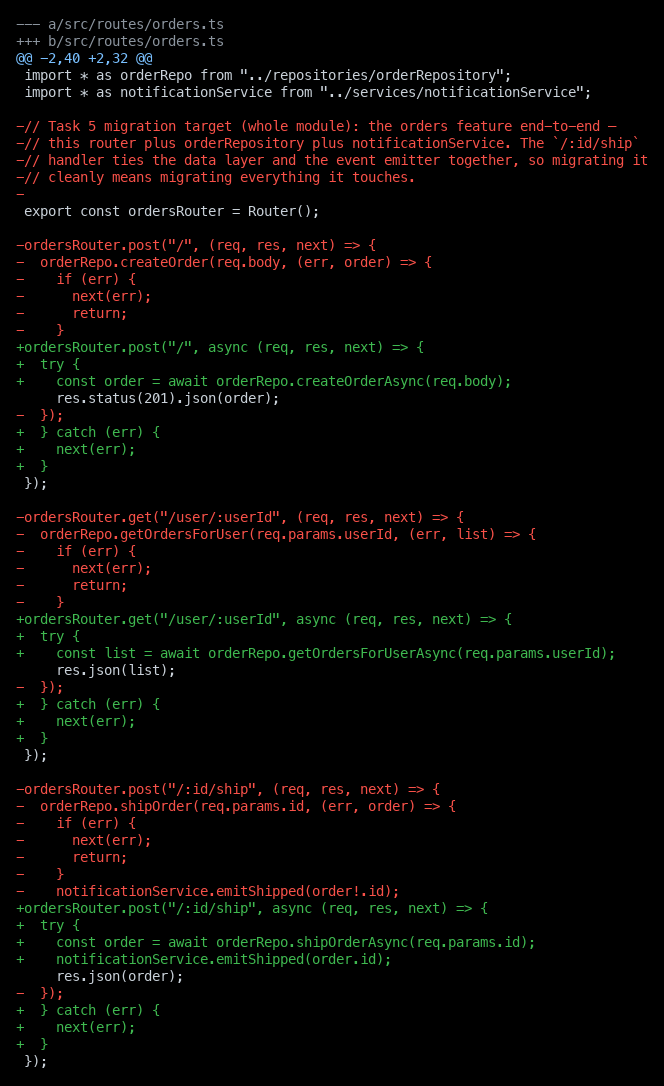
OpenCode profile
Interleaved reasoning is a property of the model and the stream, so it surfaces wherever reasoning parts are rendered. How OpenCode presents it:
- OpenCode (terminal-native): inline amber
Thought:blocks between tool calls; reasoning effort via--variant. The focus of this recipe.
Common failure modes
Each mode below shows real output and the recovery.
Incomplete migration breaks callers
Converting a function to async without updating its callers is a common dependency-order miss. The callers still pass a callback to a function that no longer takes one, so the build breaks. The cross-file reasoning in task 3 avoids this.
text
Recovery: Migrate in dependency order (leaf functions first), or raise --variant so the model reasons about callers before it edits. Run tsc --noEmit after every change and feed errors back to the model.
A budget set too low adds turns
--variant minimal does not always finish faster. With a thin per-turn budget the model acts before it has reasoned through the change, then spends extra turns recovering. On task 2, minimal takes 15 turns and 1500 reasoning tokens against high's 12 turns and 817. Measure end-to-end, not per call, and raise effort on the turns that decide structure.
A dropped or truncated stream
If the connection drops mid-turn you get a turn with no reasoning, content, or tool call. It shows up as an empty turn in the trace:
text
Recovery: Re-run the turn. Treat an empty turn as a transport failure, not a model decision.