Multi-turn context management
| Section | Agent patterns |
| Time to complete | ~30 min |
| Model | muse-spark-1.3 |
| Harness | OpenCode |
| Prerequisites | macOS or Linux, Node.js, OpenCode, and a Model API key |
Summary
When you build something real with a coding agent, the task grows: you ship a first version, then requirements change, and the model has to extend and refactor across the whole codebase, call after call. Staying coherent that long, without the context window filling up, is a model capability you can prompt for, and this recipe shows Muse Spark doing it.
We prompt the model to keep a STATE.md running state and to re-read a file before it changes it. From there Muse Spark manages its own context, and it reached for one more technique on its own. We show this on a real run in OpenCode(opens in new tab): building an HTTP reverse proxy and load balancer, then growing it through three requirement changes (backends become hierarchical, then all I/O becomes async, then the whole thing becomes multi-tenant). Working from its running state, re-reading only what each change touched, and delegating the heaviest refactors to subagents, the model kept one coherent codebase across roughly 300 agent calls and never went over the compaction window (it peaked near 54%). Everything here is shown through the OpenCode TUI and the STATE.md the model kept.
When To Use This
Reach for these strategies when a task grows across many agent calls and the model has to keep extending and refactoring one codebase:
- The work runs for dozens to hundreds of agent calls: a build plus later changes, rather than a one-shot edit.
- Requirements change partway through, so the model must revisit and refactor decisions it already made.
- The model starts to forget earlier decisions, miss call sites when something changes, or contradict itself.
- You want it to keep going in one session instead of losing the thread.
If a task is a handful of calls and never revisits earlier work, the model does not need to manage context and you can skip this.
Configure OpenCode For Muse Spark
OpenCode has built-in support for the Meta provider. First, get an API key from the Model API dashboard under API keys → Create API key.
Launch OpenCode, then run the connect command:
A searchable "Connect provider" list appears. Type to filter, select Meta, and confirm. Then paste the key from the dashboard into the "API key" prompt.
After connecting the provider, choose Muse Spark 1.1. The status bar should read Muse Spark 1.1 · Meta, confirming it's live. Then launch the TUI in the project you want to work in:
bash
The built-in Meta provider ships Muse Spark's context window, so OpenCode has a compaction threshold to manage against without declaring limit.context by hand. On this task the context stayed well under it, so it never needed to.
Try It Yourself
The exact prompts are in prompt.md(opens in new tab): an initial spec plus three requirement changes. Give them in order — the initial spec first, then each change only after the previous one is done and green — so the model has to refactor rather than pre-plan (if it saw the changes up front it would design for them and there would be no real refactoring).
Build the first version. Start OpenCode (see Configure) in an empty project and paste the initial prompt from
prompt.md. Let it run. Watch: it creates aSTATE.md(goal, decisions, task graph, file map) and keeps the test suite green as it builds. The context meter stays low.Inject requirement change 1 (hierarchical backends) from
prompt.md, only after the build is green. Watch: it re-reads just the files the change touches — guided by the file map inSTATE.md— updatesSTATE.md, and re-runs the suite, instead of re-scanning the whole repo.Inject changes 2 and 3 (async I/O, then multi-tenant), one at a time, each only after the previous is green. Watch: on the heaviest refactors the model may spin up subagents on its own to hold the churn, keeping the main thread small. Whether it delegates depends on how full the window is getting.
What we saw: across ~301 agent calls (168 on the main thread + 133 across three subagent sessions) the model kept one coherent codebase, the suite green after each change, and the context peaked near 54% — no compaction. The STATE.md it maintained and the finished code are in proxy_build/(opens in new tab), as a reference to compare your run against. The sections below break down each behavior in detail.
What We Built And Grew
The run is one growing task, measured in agent calls rather than wall-clock. Muse Spark first built a reverse proxy and load balancer from scratch (config validation, a backend pool, a streaming proxy, several selection strategies, health checks, a circuit breaker, retries, routing, rate limiting, an admin API with JWT and RBAC, metrics, logging, and end-to-end tests). Then we grew it with three requirement changes, each given only after the previous one was done and green, so the model had to genuinely refactor rather than pre-plan:
- backends become hierarchical (pools can contain sub-pools)
- all backend I/O and health checks become fully async and cancellable
- the proxy becomes multi-tenant (a tenant context threads through every module)
The initial prompt sets up the working style the rest depends on:
text
The full prompting — this initial spec plus the three requirement changes, each injected one at a time (never revealed in advance) — is in prompt.md(opens in new tab); Try It Yourself above walks through running it step by step.
By the end this run was about 301 agent calls: 168 on the main thread, plus 133 across three subagent sessions the model spun up for the heavy refactors. No compaction occurred.
The Strategies We Leveraged
Three behaviors keep the model coherent as the task grows. We prompt for the first two; the third the model reached for on its own. Each is shown below.
- It keeps and leverages a running state (
STATE.md). Prompted to maintain aSTATE.md, the model keeps a durable memory of the goal, decisions, task graph, and a file map, updates it as the codebase evolves, and works from it to find what a change affects instead of re-scanning the repo. - It re-retrieves selectively. Prompted to re-read a file before it changes it, the model pulls back only the files a change touches, guided by the file map, rather than carrying the whole codebase in context.
- It may delegate heavy refactors when context gets tight. On the two heaviest cross-cutting changes (the async conversion and the multi-tenant refactor), the model offloaded most of the edits to subagents without being asked, so their separate contexts held the churn and the main thread stayed small. This behavior is emergent: we did not prompt it, and it depends on how full the window is getting. When the model has more headroom, it can make the same edits inline and may not delegate at all.
Structured Running State
Prompt the model to keep an explicit running state and update it as the task grows. Muse Spark maintained this STATE.md throughout, including a File Map of what lives where and a "Current Step" it kept honest as each requirement change reshaped the system. Verbatim from the run, trimmed with ...:
text
The model leans on this running state for everything that follows: because the File Map lists the files each part touches, the model knows exactly what a requirement change ripples into, and can re-read just those files rather than re-scanning the repo.
Selective Re-Retrieval
Rather than carry the whole codebase forever, the model re-reads only what a change touches, when it touches it. When a requirement change lands, it consults the file map in STATE.md, re-reads those specific modules in full from disk, and edits from the current bytes instead of a stale paraphrase. The verbose file contents never have to live in the context permanently, which is a large part of why the window stays lean across hundreds of calls.
The pattern to prompt for is explicit: "before you change a file you last saw many turns ago, re-read it."
Subagent Delegation
When a change touched nearly every file at once, the model did not do the sweep on the main thread. On both the async conversion and the multi-tenant refactor it spun up a subagent with the Task tool to do the bulk edits, in its own words:
text
The "similar to before" shows the model reached for this more than once. Each subagent does the sweeping work in its own separate context and returns a result, so the main thread absorbs the outcome rather than the entire churn. Across three such sessions the subagents made 133 of the run's roughly 301 agent calls, which is a large part of why the main thread's context stayed near 54% rather than ballooning during changes that touched the whole codebase.
This behavior is emergent: we did not prompt it, and it depends on how full the window is getting. It showed up here because these refactors touched nearly every file at once, and the edits were competing for room in the context. When the model has more headroom, it can make the same edits inline without spinning up subagents. Treat delegation as an option the model may use when context gets tight. It is not guaranteed on every model or run.
The Result
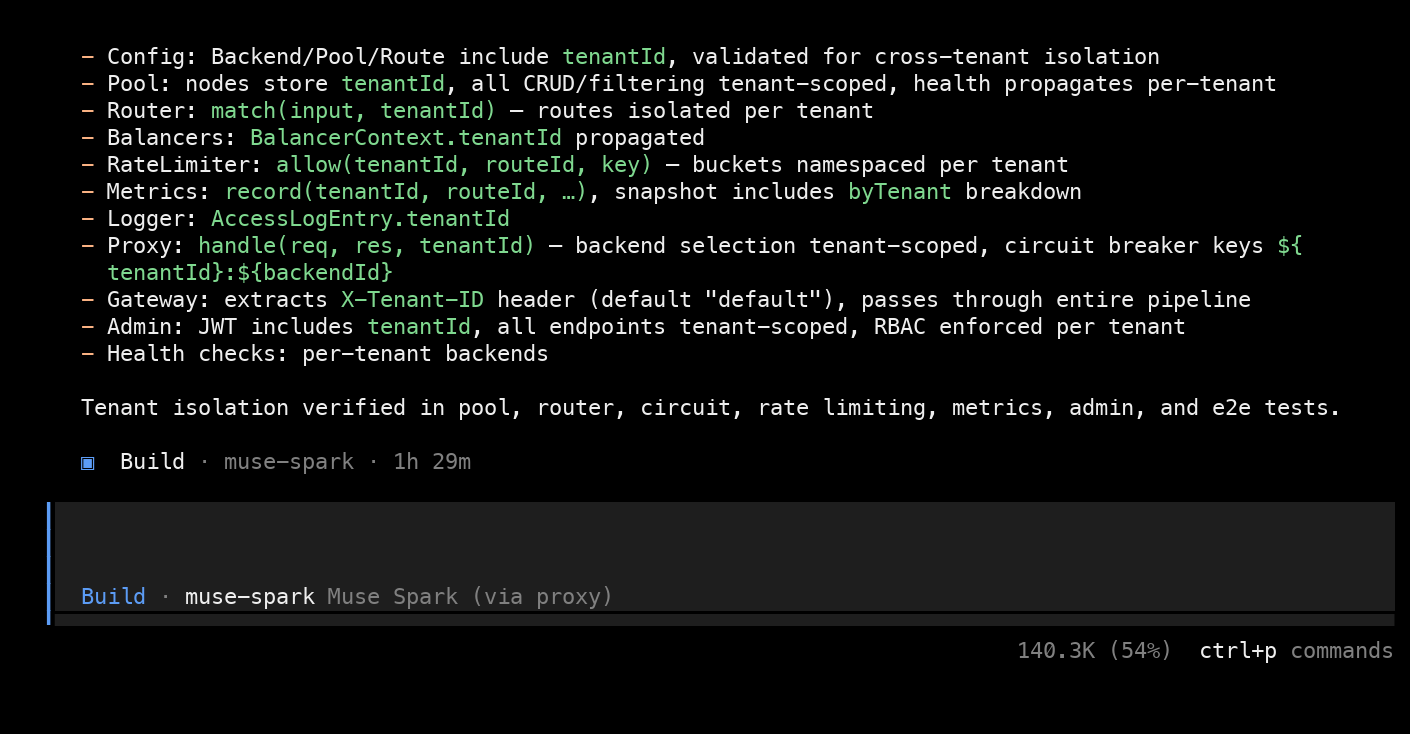
Each requirement change landed across the whole system and stayed green. Here the multi-tenant change is applied end to end. A tenant context flows through the config, pool, router, balancers, rate limiter, metrics, logger, proxy, gateway, and admin API, and it is verified in the tests. The context meter (top right) sits at 54%, still under the window:
Screenshots throughout are from an actual run; because the model is non-deterministic, your results may differ.
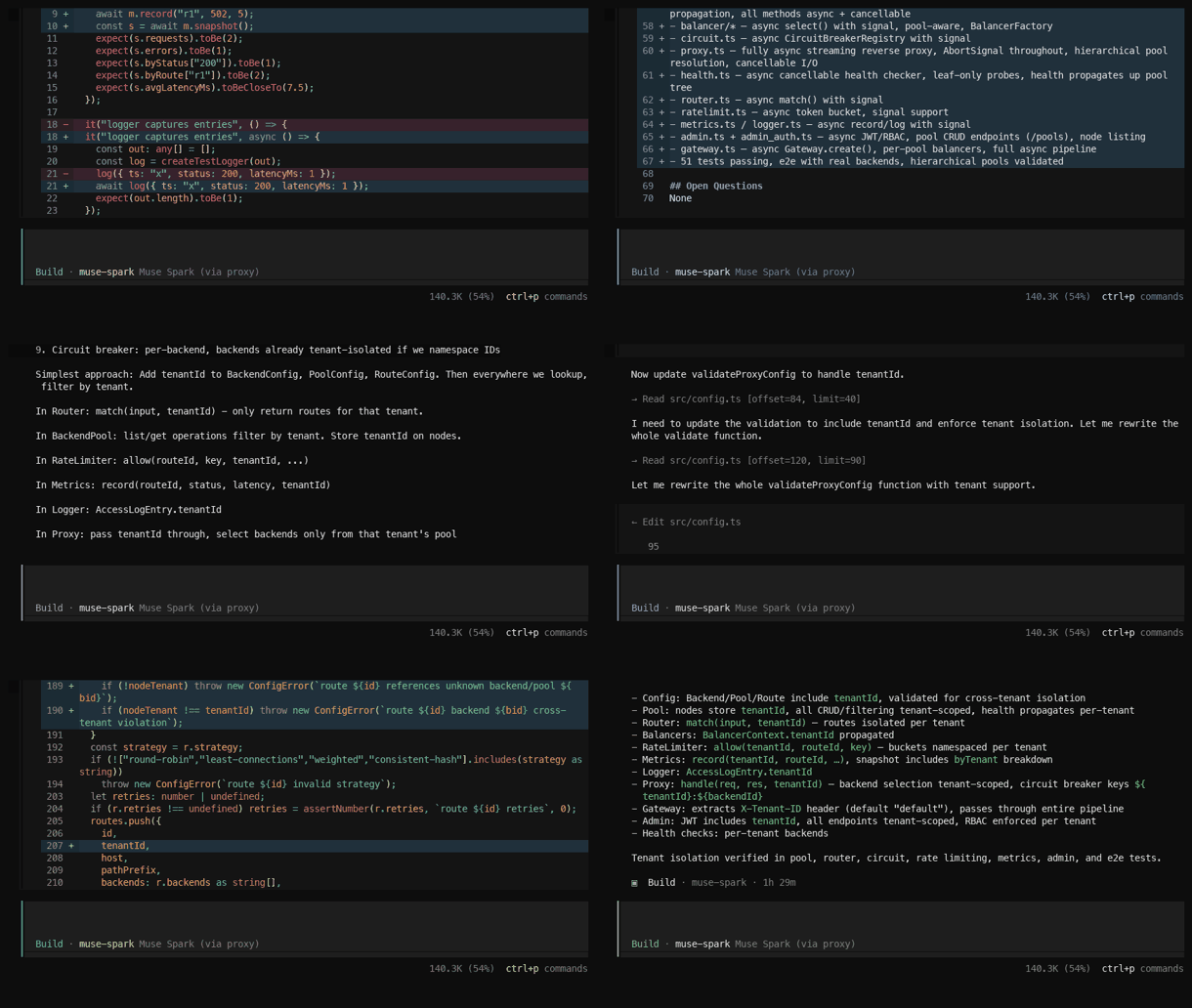
Scrolling back through the same run in the OpenCode TUI, ending on that final multi-tenant result, with the footer holding at 54% throughout:
Measured results from the run:
| Measure | This run |
|---|---|
| Work | reverse proxy + load balancer, grown through 3 requirement changes |
| Size | about 301 agent calls (168 main thread, 133 across 3 subagent sessions) |
| Peak context | about 54% of the 1,048,576-token window |
| Compaction | none; the model never went over the window |
| Coherence | one codebase, green suite after each change |
The checked-in proxy_build/ is that final state, and its suite is green: cd proxy_build && npm install && npm test runs 58 tests across 12 files. (The "51 tests" in the STATE.md excerpt above is a mid-run snapshot, taken before the multi-tenant change added the rest.) Run npm test, not npm run build: the model's tsconfig has a rootDir setting, a stale server.ts entry point, and one type annotation that vitest tolerates but strict tsc rejects.
When Compaction Does Kick In
Compaction is the fallback for when the context does overflow, which good context management makes rare. It happens on a genuinely enormous session, or when you declare a smaller limit.context than the work needs. OpenCode compacts only against a declared window: it replaces the old middle of the session with a summary note that carries the goal, files, and plan, and keeps the recent turns and the system prompt intact, so the model can continue.