Search-and-replace edits
| Section | Agent patterns |
| Time to complete | ~15 min |
| Model | muse-spark-1.3 |
| Harness | OpenCode |
Summary
A model's first job inside a coding CLI is changing code without degrading quality.
Search-and-replace edits give the model a constrained way to modify existing files: provide the exact text currently in the file, provide the replacement text, and apply the change only when the existing text matches exactly once. This keeps edits reviewable, prevents accidental rewrites, and gives the harness a simple validation rule.
This recipe teaches the pattern, shows how OpenCode implements it, and walks through six real edits — with the tool-call payloads Muse Spark emitted and the diffs they produce. The sample project is segment-anything(opens in new tab), a real Python codebase.
When does the CLI use search-and-replace edits?
The CLI reaches for a search-and-replace edit when it is modifying an existing file and the change can be anchored to exact current text. It uses one when:
- It is changing an existing file rather than creating a new one.
- It can quote the exact current text, and that text appears exactly once (or it includes surrounding lines to make the target unique).
- The change can be expressed as one or more focused replacements rather than a full rewrite, which would risk unrelated changes.
It falls back to a whole-file write only for new files. Everything else, including beginning-of-file or end-of-file additions, is a search-and-replace edit anchored on the adjacent lines.
The edit contract
The model emits a search/replace edit: the exact existing text to find, and the new text to swap in. Your harness locates the search text and replaces it, leaving the rest of the file untouched. One rule keeps this safe: the search text must match exactly once. Zero matches means the model hallucinated the original, so reject it; more than one match is ambiguous, so add surrounding context.
How OpenCode implements the pattern
OpenCode applies this through a structured edit tool call. The model names the file with an absolute path and supplies the exact text to replace; OpenCode applies it and shows the diff inline. A separate write tool creates whole files. The fields map onto the pattern, and OpenCode enforces the same exactly-once rule: an edit fails if oldString is missing or appears more than once.
| Pattern | OpenCode tool |
|---|---|
| search text | edit oldString (must match exactly once) |
| replacement | edit newString (must differ from oldString) |
| add context to disambiguate | extra lines inside oldString |
| change every occurrence | edit replaceAll: true |
| create a new file | write { filePath, content } |
OpenCode requires a read of a file before it will edit or overwrite it, so the model works from the current bytes rather than a guess.
Configure OpenCode for Muse Spark
Install OpenCode if you haven't already (npm i -g opencode-ai).
Step 1 — Connect the Meta provider
OpenCode has built-in support for the Meta provider.
First, get an API key from the Model API dashboard under API keys → Create API key.
Launch OpenCode, then run the connect command:
A searchable "Connect provider" list appears. Type to filter, select Meta, and confirm. Then paste the key from the dashboard into the "API key" prompt.
Step 2 — Select Muse Spark 1.1
After connecting the provider, choose Muse Spark 1.1. The status bar should read Muse Spark 1.1 · Meta, confirming it's live.
Try it on the sample project
The sample project is segment-anything(opens in new tab), Meta's image-segmentation library. Clone it at a pinned commit so the text and line numbers in this recipe match what you edit:
bash
The package is plain Python, so a lightweight check tells you whether an edit broke anything, with no model weights or GPU needed:
bash
Each example below shows the prompt typed into OpenCode, a screenshot of the run, the tool-call payload Muse Spark produced, and the resulting diff.
1. Single-line change
Prompt:
In segment_anything/build_sam.py, change the SAM input image size in _build_sam from 1024 to 512. Make a precise in-place edit; do not rewrite the file.
What to notice: One edit call. Muse Spark changes a single line but quotes a few surrounding lines in oldString so the match is unambiguous. The diff is still one line.
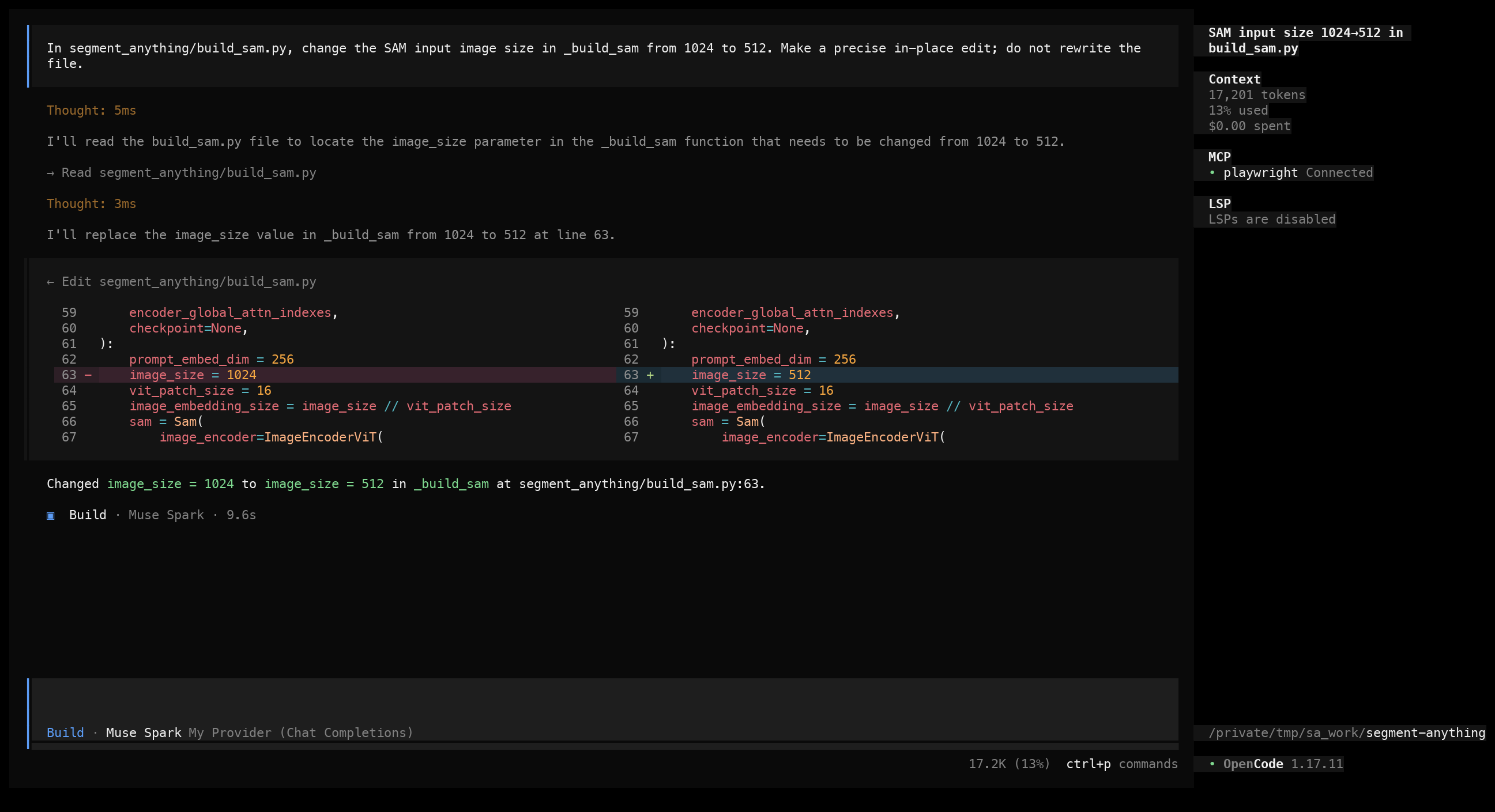
Edit payload (1 edit call):
json
Resulting diff:
diff
2. Multi-line rewrite
Prompt:
In segment_anything/build_sam.py, make checkpoint loading CPU-safe: pass map_location="cpu" to torch.load inside _build_sam. Edit the existing block in place.
What to notice: One edit call replacing the checkpoint-load block. oldString spans the whole if block, so the match is unique and the indentation is preserved exactly.
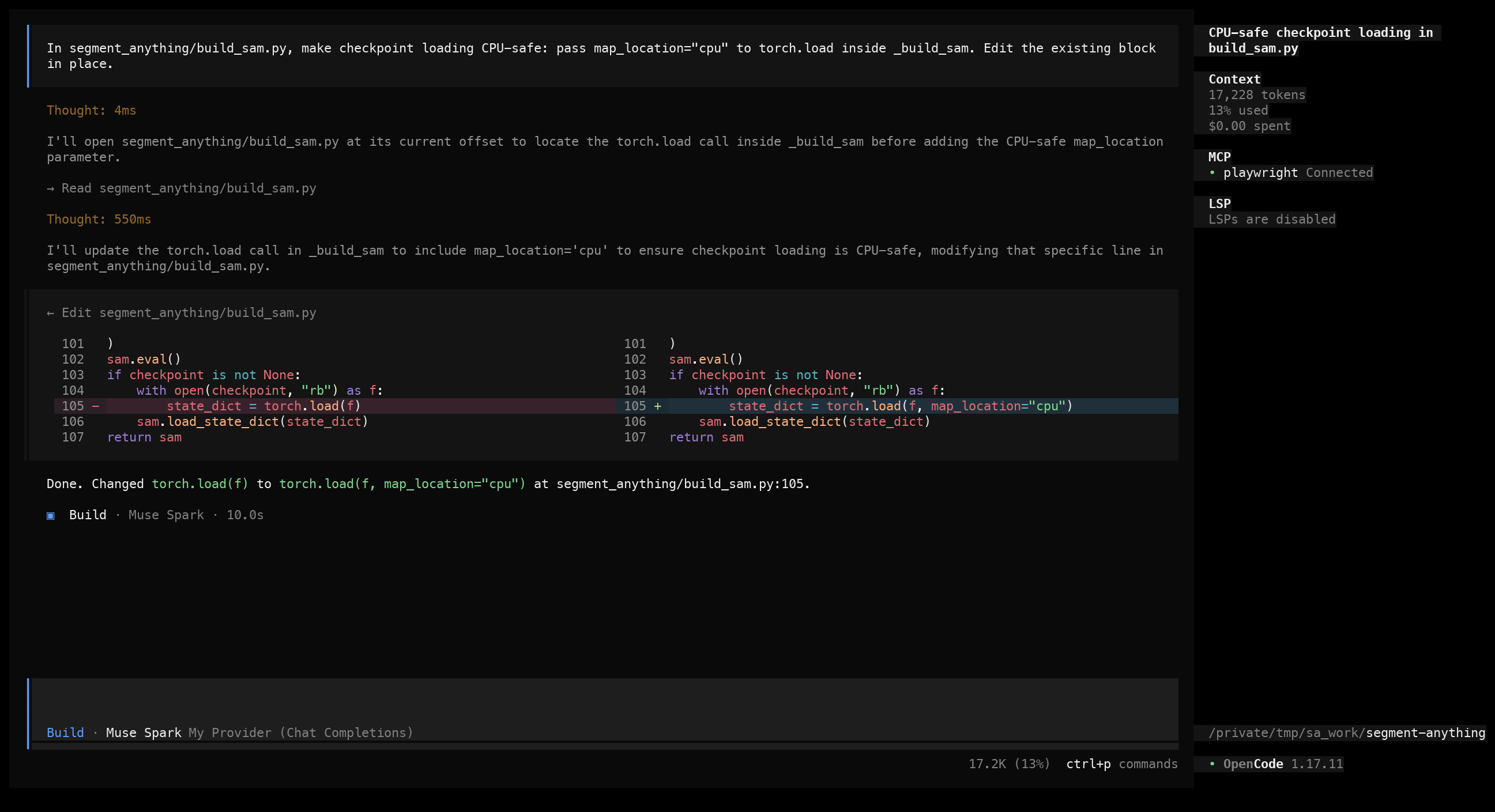
Edit payload (1 edit call):
json
Resulting diff:
diff
3. Multiple edits in one file
Prompt:
In segment_anything/build_sam.py, add a one-line docstring to each of the three public build functions (build_sam_vit_h, build_sam_vit_l, build_sam_vit_b) describing the model size.
What to notice: Three edit calls against one file. Muse Spark anchors each one on its unique def line, so the three matches do not collide.
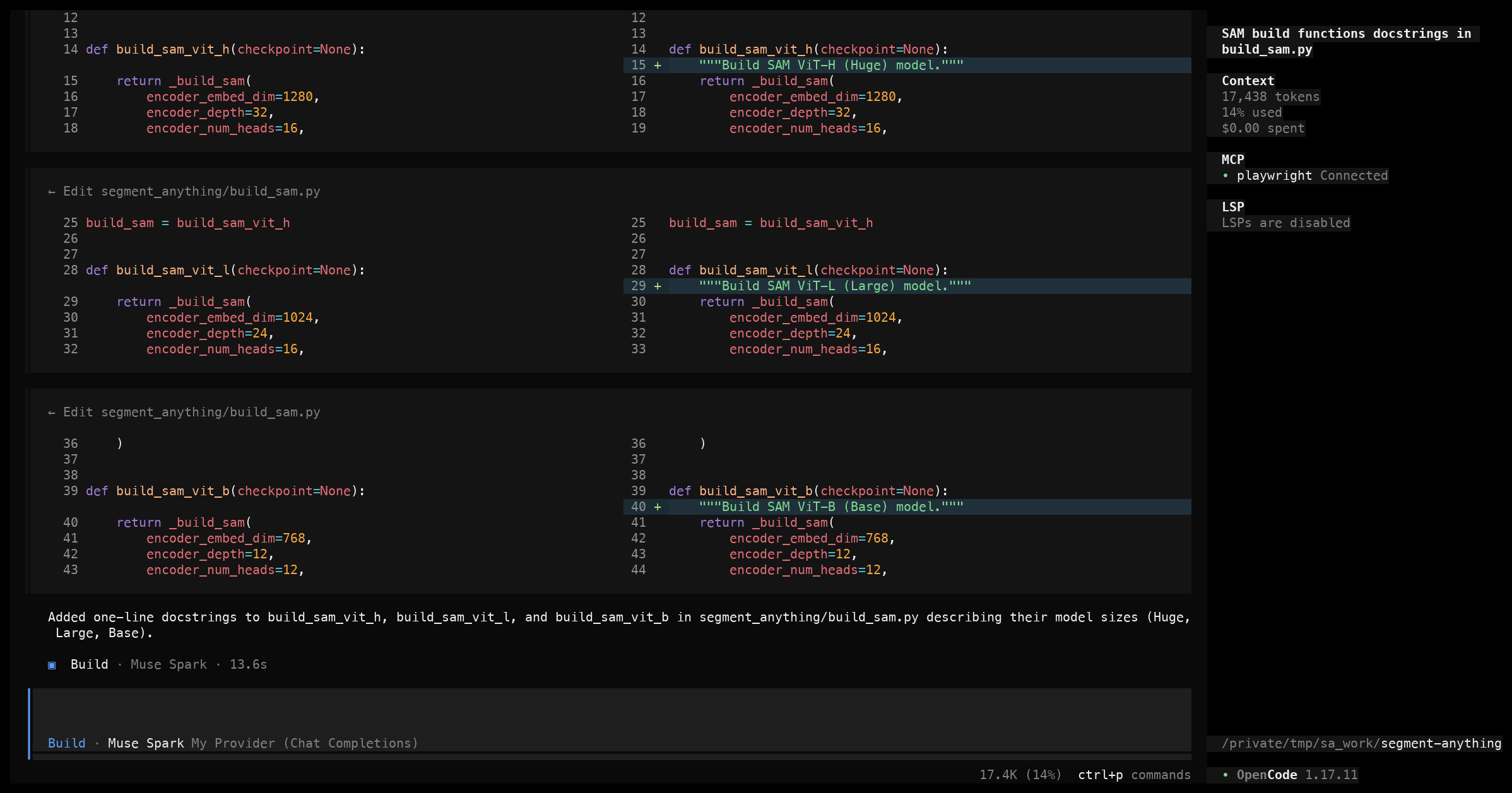
Edit payload (3 edit calls):
json
Resulting diff:
diff
4. New file plus existing-file edits
Prompt:
Add a version module: create
segment_anything/version.pydefining__version__ = "1.0"with the repo license header, then export__version__fromsegment_anything/__init__.py.
What to notice: A write for version.py plus an edit in __init__.py. The new file goes through write (whole content, no oldString); the export is an anchored edit on the existing import block.
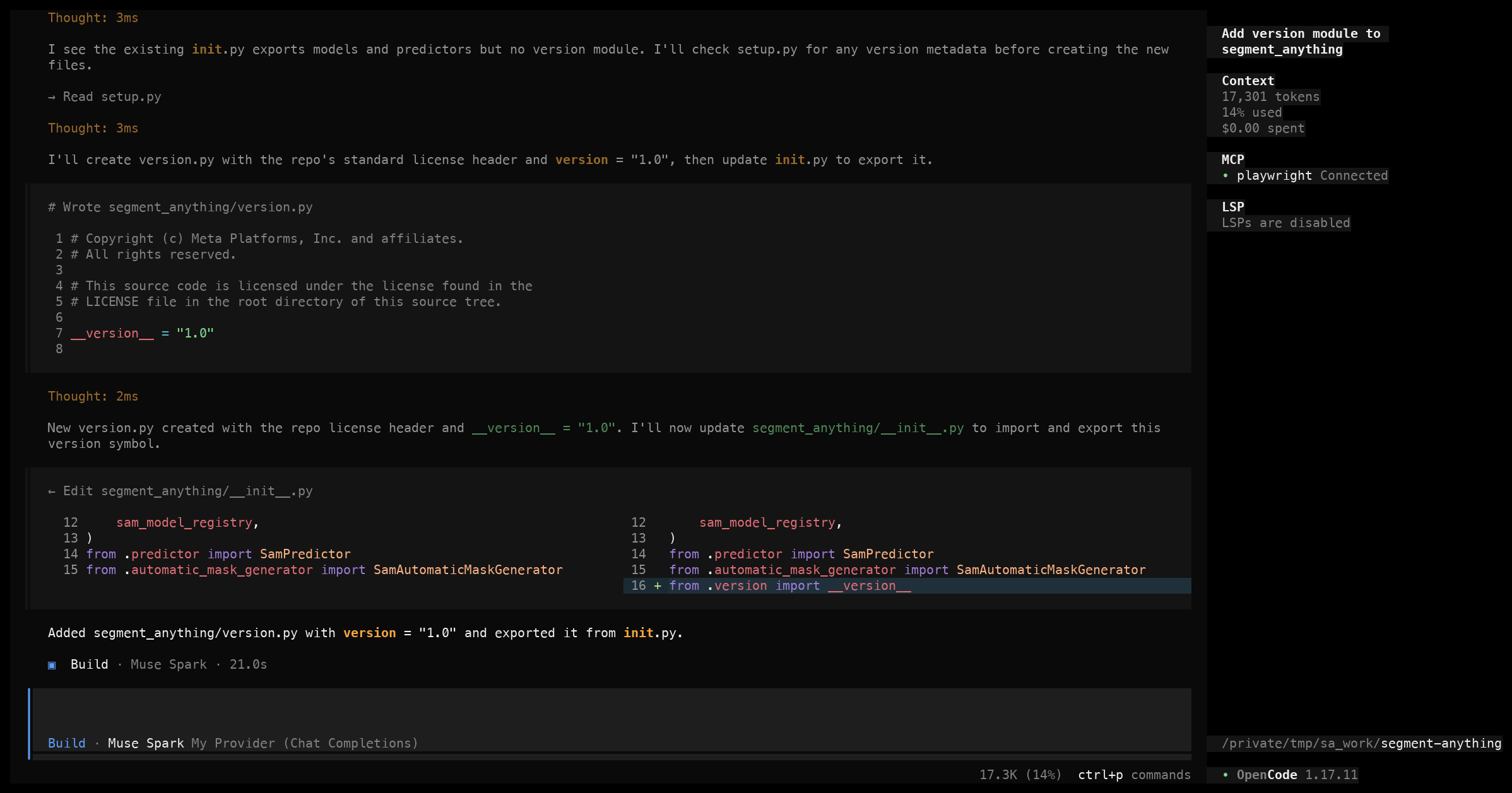
Edit payload (1 write + 1 edit call):
json
Resulting diff (new file):
diff
Resulting diff (__init__.py):
diff
5. Disambiguating repeated code
Prompt:
In segment_anything/build_sam.py, change ONLY build_sam_vit_l encoder_num_heads from 16 to 8, not the identical value in build_sam_vit_h.
What to notice: encoder_num_heads=16 appears in both build_sam_vit_h and build_sam_vit_l. Muse Spark pulls vit_l's unique lines (encoder_embed_dim=1024, encoder_depth=24) into oldString so only vit_l changes.
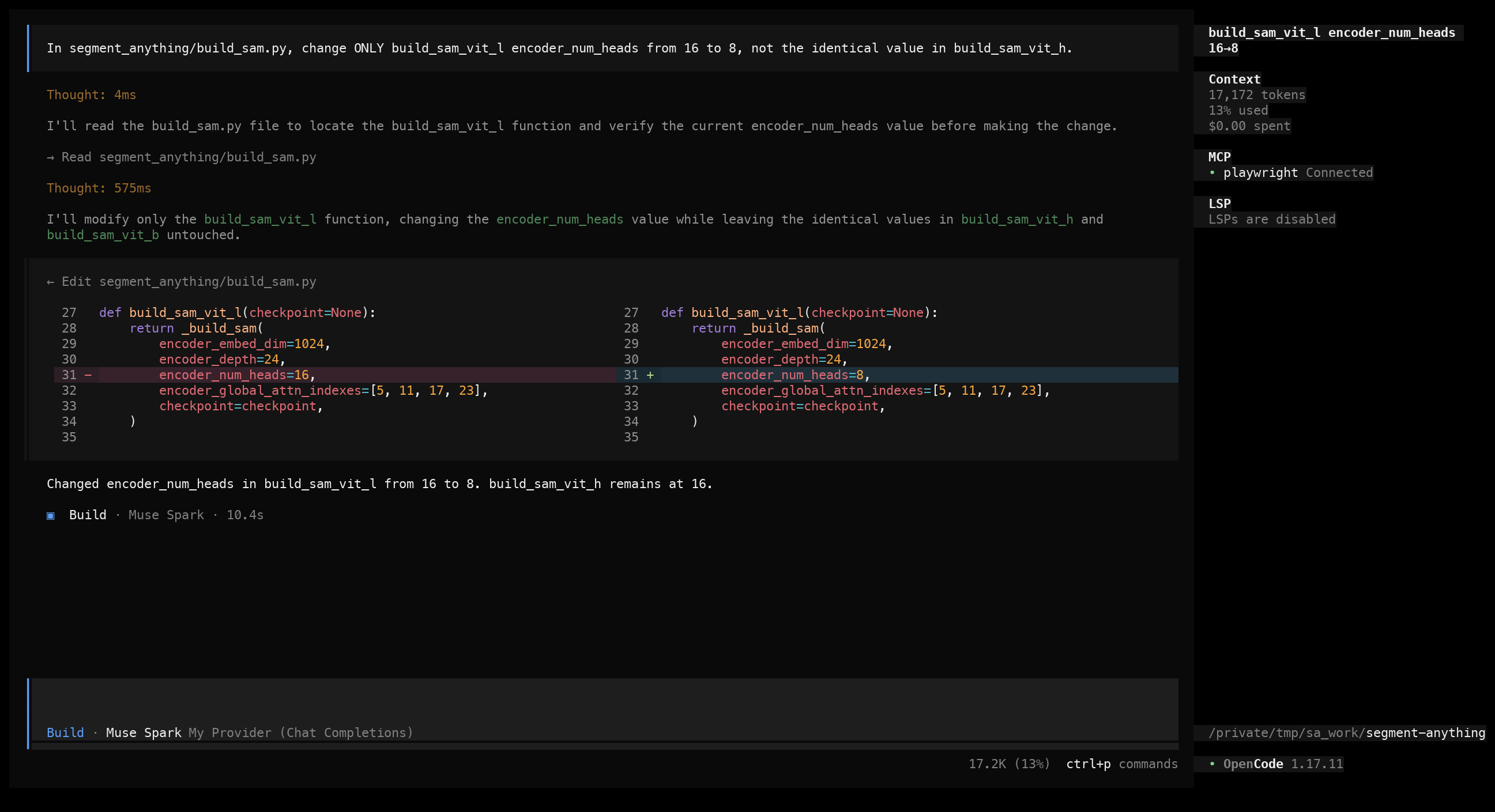
Edit payload (1 edit call):
json
Resulting diff:
diff
6. Beginning-of-file insertion
Prompt:
At the top of segment_anything/predictor.py, above the imports, add a one-line module comment: # SamPredictor: image embedding and prompt-based mask prediction.
What to notice: OpenCode has no insert mode. Muse Spark expresses the insertion as a normal edit: it quotes the license block and the first import in oldString, then re-emits them with the comment between.
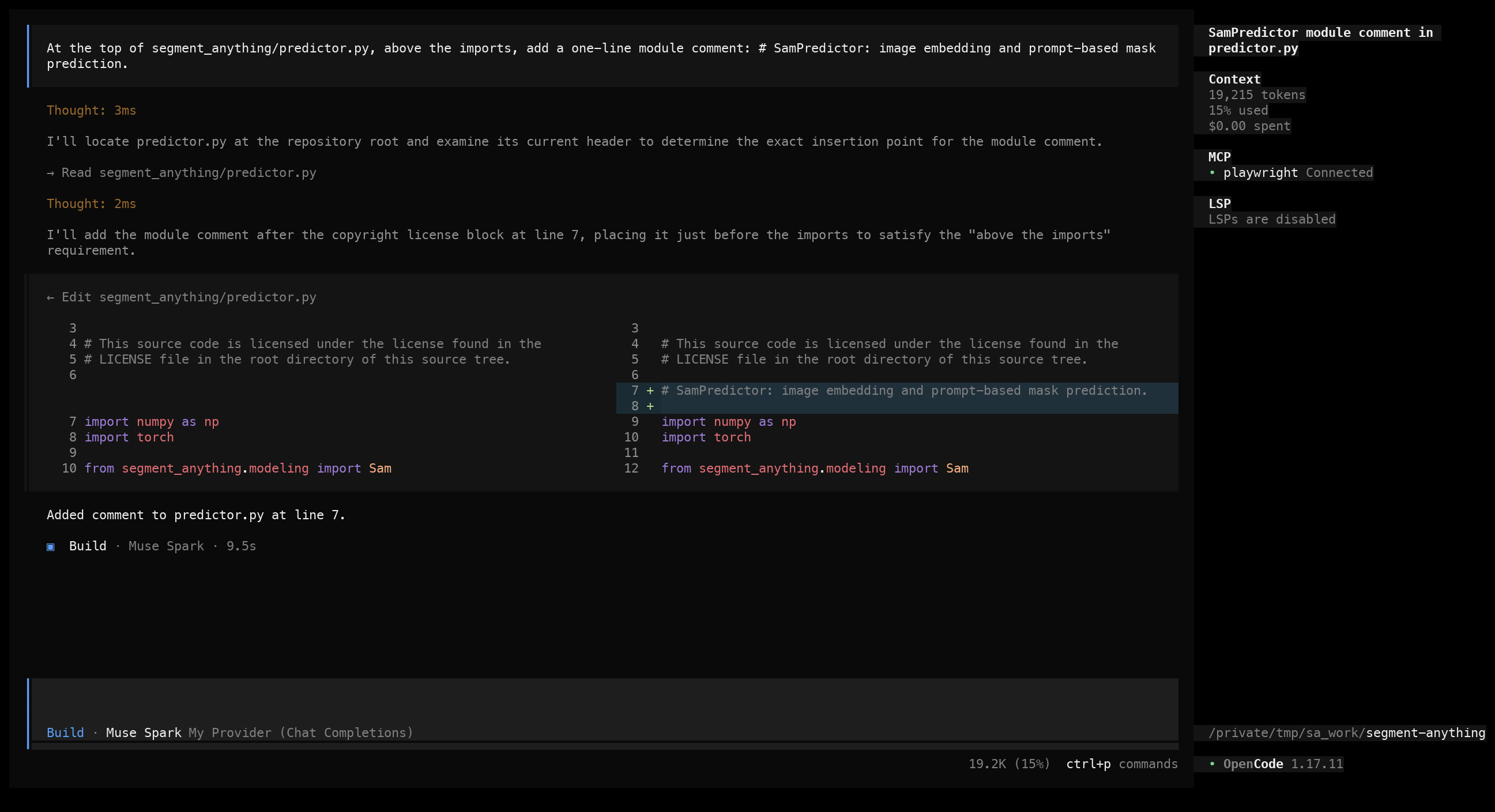
Edit payload (1 edit call):
json
Resulting diff:
diff
OpenCode profile
The safety contract holds whatever the tool shape: identify the existing text, make the replacement explicit, and reject ambiguous matches. How OpenCode expresses it:
- OpenCode: structured
edit({ filePath, oldString, newString, replaceAll? }) andwrite({ filePath, content }) tool calls. The focus of this recipe.
Common failure modes
The exactly-once contract is what keeps these edits safe. Here are the ways an edit goes wrong, and how to recover.
Whitespace mismatch
oldString differs from the file by a space or an indent, so it matches zero times and the edit is rejected. Copy the bytes exactly; don't normalize or re-indent.
Recovery: Re-read the file and copy oldString verbatim, or ask OpenCode to read the file again and retry.
Ambiguous match
oldString appears more than once, so the edit is ambiguous and gets rejected. This is the case in task 5: a bare encoder_num_heads=16 matches both build functions.
Recovery: Add surrounding lines so the match is unique, or set replaceAll when you really do mean every occurrence.
Whole-file rewrite
The model puts the entire file in one edit call instead of a targeted edit. It still applies (the oldString matches once), but it re-emits every line, which is slower and can introduce unrelated changes.
Recovery: Prompt for precision: make the smallest possible edit, changing only the affected lines.
Overwriting a file with write
The model reaches for write on a file that already exists. write replaces the whole file, so this discards the current contents instead of editing in place. Reserve write for files that do not exist yet.
Recovery: Use edit for in-place changes; reserve write for files that do not exist yet.
Applies cleanly but breaks the build
The edit matched and applied, but it introduced an undefined name (imag_size instead of image_size). Applying cleanly is not the same as being correct — a compile or lint check is what catches this:
text
Recovery: Run py_compile and flake8 after every edit, then feed any error back to the model to fix.
Files in this recipe