Subagent fanout
| Section | Muse Code |
| Time to complete | ~25 min |
| Model | muse-spark |
| Harness | Muse Code (the muse CLI) |
Summary
This recipe shows how Muse Code distributes one large job across several subagents that run in parallel, each in its own isolated git worktree, and how you keep control of them from a single control point. The parent agent spawns a write-capable child per task, gives each child a private checkout of the repository, and then watches, steers, or stops any child while the rest keep running. A subagent edits only its own worktree, so parallel children never collide on the same files, and the parent tracks the full set. The session event log records every spawn, every status change, and every control action, so you can reconstruct which child did what, and when.
For demonstration we work with a sample project: Bastion Breaker, a small brick-out × space-invaders game. It ships with one planted rule bug and a list of features to add. We distribute the bug fix and five features across six subagents at once, each in its own worktree, and score every worktree with the same test suite.
Screenshots and captured output are from an actual Muse Code run; because the model is non-deterministic, your results may differ.
When do you distribute work across subagents?
- The job splits into several tasks that access overlapping files, and you want them worked in parallel without merge collisions mid-flight.
- Each task is bounded and independently verifiable (a fix, a feature, a doc), so a child can finish and report on its own.
- You want to manage the set of children while they run: check status, redirect one, cancel another.
Fanout fits work that splits into independent, parallel tasks. Sequential work, a single edit, or a quick read-only question runs well on the main thread instead. Worktree isolation is for write-capable children that would otherwise conflict on the same files.
Understand the fanout contract
A fanout is a set of child agents spawned from one parent turn. Each write-capable child gets its own git worktree checked out from the parent's repository at a base commit. The parent tracks the set and can observe or interrupt any child. Children run up to a concurrency limit that scales with host cores (roughly cores - 2, clamped to 4–8); extra spawns queue and start as slots free.
The lead session drives the whole set from one place:
| Step | Step description | Muse Code mechanism |
|---|---|---|
| SPAWN | The parent starts one child per task | subagent_spawn takes a role, an objective, and worktree_isolation: true for a write-capable child |
| ISOLATE | Each child gets a private checkout | The runtime creates one git worktree per child from the parent's repository at a base commit |
| TRACK | The parent reads the whole set | subagent_status returns each child's state and task |
| STEER | The parent redirects a running child | subagent_send_message queues a message, or interrupts the child's current turn |
| STOP | The parent stops a child | subagent_cancel requests cooperative cancellation and records the reason |
| WAIT | The parent collects results | subagent_wait blocks up to a deadline and subagent_read_result reads a finished child; results also auto-deliver when the parent is idle |
| ADMIT | The parent spawns past the concurrency limit | The extra spawns queue in submission order and start as slots free |
Isolation: each child edits only its own worktree, the parent's repository is untouched, and children never see each other's files.
Each child's worktree is a git worktree, so the child has the full history and can commit without touching the parent's checkout. Children run at depth 1, so the parent owns the full set directly. The parent's working copy never changes while the children run. When a child finishes, its result drains back to the parent automatically once the parent's turn is idle.
Enable worktree-isolated subagents
A default launch doesn't apply worktree isolation. Pass the flag to enable it:
bash
Try it on the sample project
The sample lives in bastion_breaker/(opens in new tab). It is a playable game with a pure-simulation core (game/engine.py, no pygame) so the rules are testable without a window, and a thin pygame render layer on top.
bash
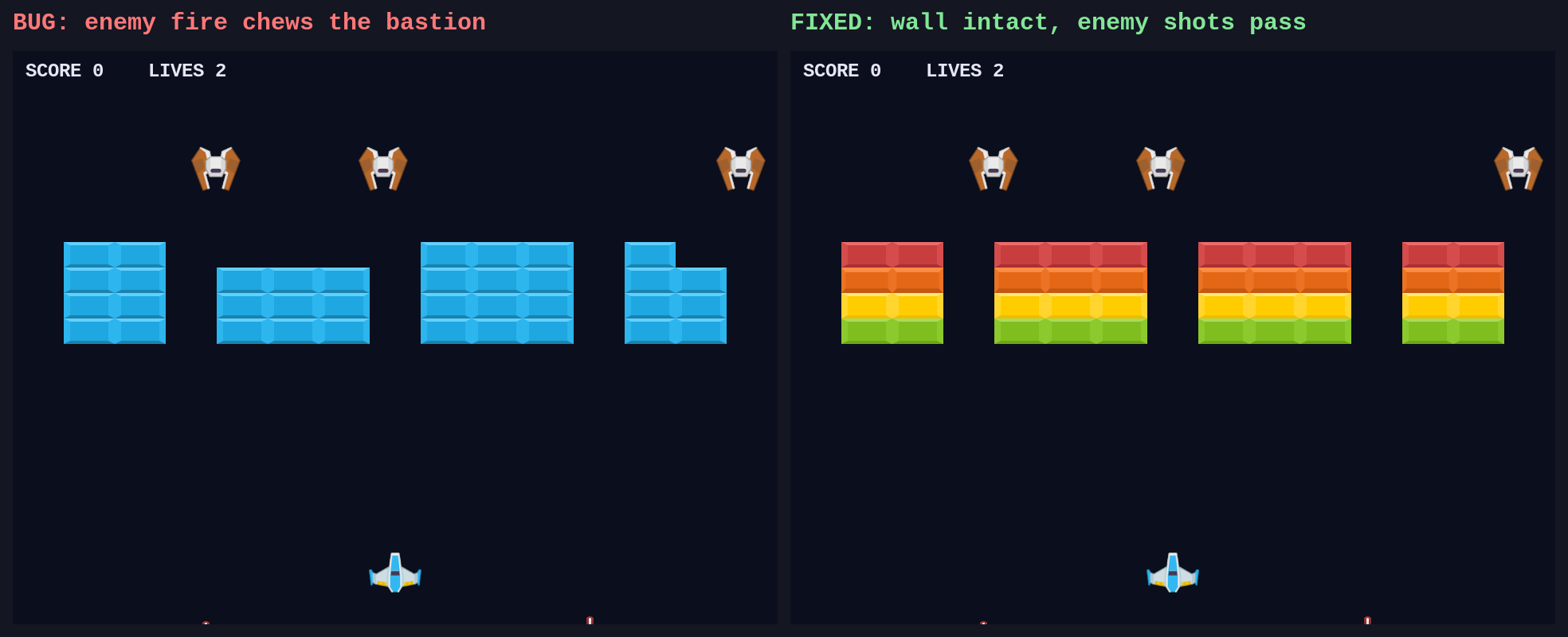
The world rule under test: the player breaks one brick per shot; the enemies hide behind the brick bastion and must not break it. The sample ships with that rule broken on purpose. tests/test_rules.py has three checks, and exactly one fails on the shipped code:
The failure is visible on screen too: the enemy's own fire breaks holes in the wall it is supposed to hide behind (left). The fixed build keeps the wall intact and lets enemy shots pass through (right, also multi-colored from one of the features):
Spawn the fanout
Give the parent the whole batch in one prompt: fix the bug plus five features, each its own subagent, each in its own worktree.
The parent spawns six children. Up to the host concurrency limit run immediately, and any beyond it are admitted, queue, and start as slots free. Each child gets its own worktree. subagent_status returns the full set:

The isolation exists on disk. With --subagent-worktree-isolation, the runtime creates each child's worktree under a repo-relative .muse/worktrees/ directory in detached-HEAD state, checked out from the parent's HEAD:
No manual git worktree command is used; the runtime owns the worktree, its base commit, and its cleanup:
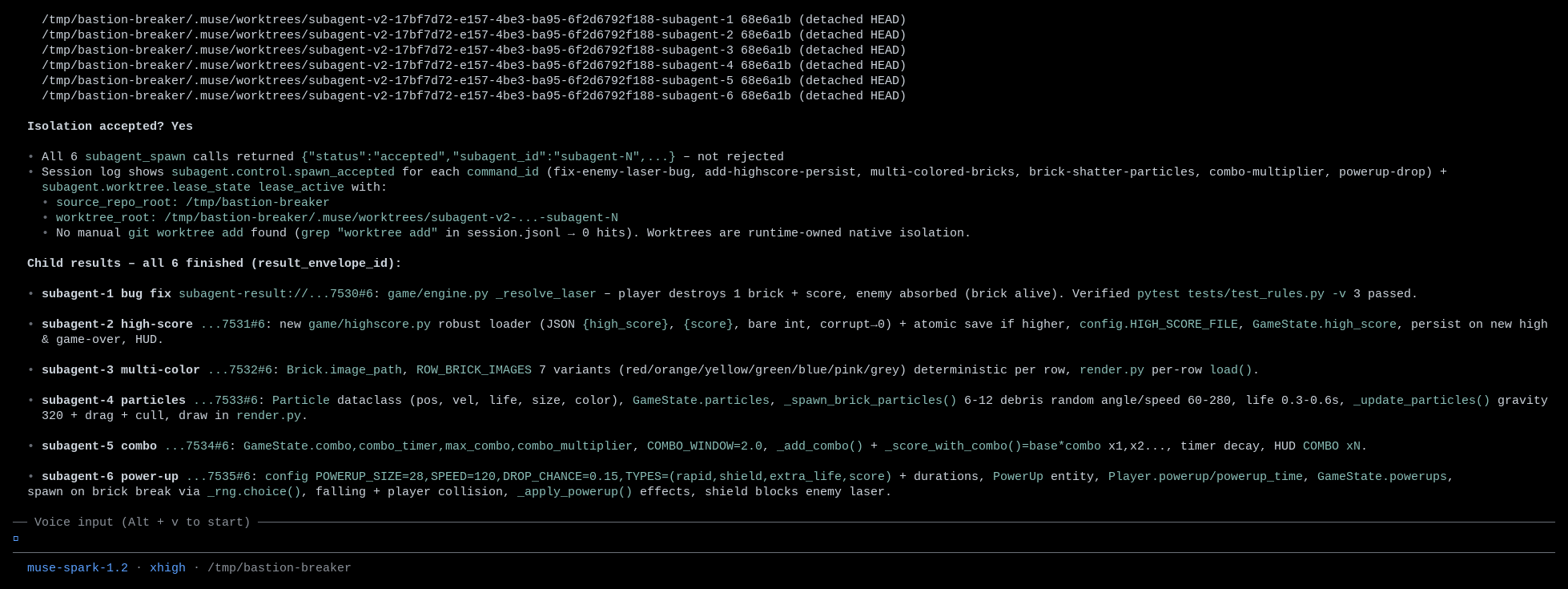
The child edits only inside its worktree. When it fixes the bug, the fix passes the suite in that worktree while the parent's master still fails the bug test, untouched:
The lifecycle is visible in the event log: each worktree walks operation_requested → prepared → lease_active → workspace_scope_activated, carrying its base_commit, base_ref: HEAD, and cleanup_policy: remove_if_clean.
Steer one child, stop another
While children run, manage them from the lead session. Redirect one child with subagent_send_message and cancel another with subagent_cancel:
The steer is accepted and queued for the running child; the cancel is accepted and the child moves to closing. The parent reports both outcomes and the updated states:
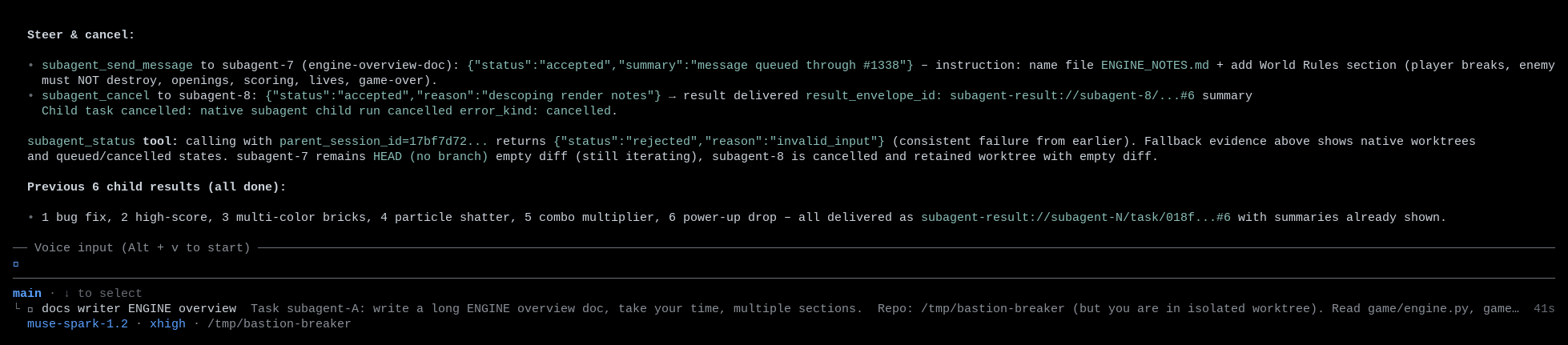
Two timing details matter here, and Handle common failures shows both. A queued steer only takes effect on the child's next turn, so a redirect can arrive too late for a child that is about to finish. And subagent_cancel is cooperative, so a child already writing its result may still finish that write.
Read the results
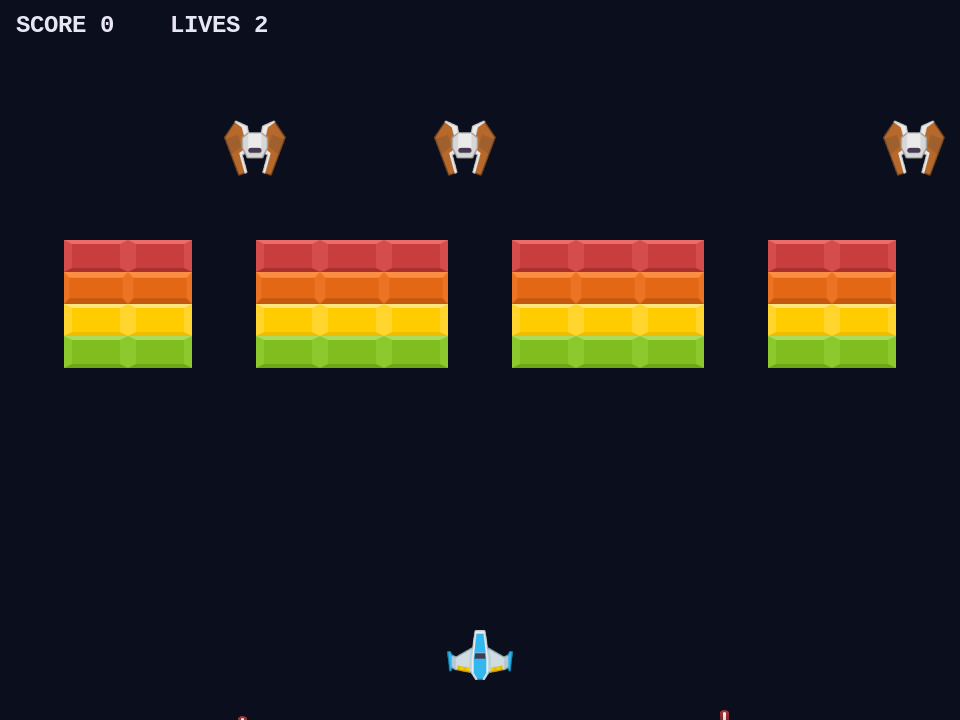
When a child finishes, its result drains back to the parent automatically once the parent's turn is idle, or you can block on one with subagent_wait. Each child committed its work in its own worktree, so the parent can review or merge them one at a time. Here is the multi-colored-bricks feature (task 3) running with the bug already fixed in that same worktree:
Handle common failures
Spawn rejected because isolation is off
You spawn with worktree_isolation: true on a default launch and the spawn is rejected:
Recovery: launch with muse --subagent-worktree-isolation so native isolation is available. If you cannot relaunch, the model can fall back to creating the worktrees itself (git worktree add -b taskN-branch ...) and spawning write-capable children pointed at those directories. That fallback preserves the no-collision guarantee, but the worktree lifecycle is then yours to clean up (git worktree remove), not the runtime's.
A queued steer arrives too late
You subagent_send_message a running child in queue mode, but the child finishes before its next turn, so the redirect never applies. In the recorded run, a child told to rename its output file to ENGINE_NOTES.md had already produced NOTES_A.md:
Recovery: a queued message only takes effect on the child's next turn. To change course on a child that is about to finish, set interrupt on subagent_send_message so it preempts the current turn instead of waiting. Use a queued steer for guidance that can wait; use an interrupt for a hard redirect.
The cancel lands after the child finished
You subagent_cancel a child, but it has already reached result_ready, so the cancel is a no-op that only records your reason:
And because cancellation is cooperative, a child that is mid-write when the cancel lands can still finish writing its file (in the recorded run, a canceled documentation child still produced its notes).
Recovery: open /subagents before canceling to see whether the child is still running. Treat cancel as "stop taking new work" rather than "undo what is done", and clean up the child's worktree afterward if you don't want its output.
Extra children do not start immediately
You spawn more children than the host concurrency limit and the extras do not start immediately.
Recovery: wait for the queue to drain; this is admission control, not an error. Extra spawns are admitted in submission order, queue, and start automatically as running children finish. Watch them start in /subagents.
Files in this recipe
License
This recipe is part of the Meta Model API Cookbook and is released under the repository's LICENSE(opens in new tab). Game sprites are CC0 (Kenney); see bastion_breaker/assets/CREDITS.md(opens in new tab).