Accelerating the fine-tuning process with more control over model weights
At a glance
Industry
TechnologyUse case
Streamlining the model iteration processGoal
Give users more control over model weights to speed up the iteration cycleLlama versions
Llama 3.1 8B, Llama 3.2 1B, Llama 3.2 3B, Llama 4 Scout, Llama 4 Maverick, Llama 3.1 70B, Llama 3.1 405BDeployment
AWS
Making it easier to track what works
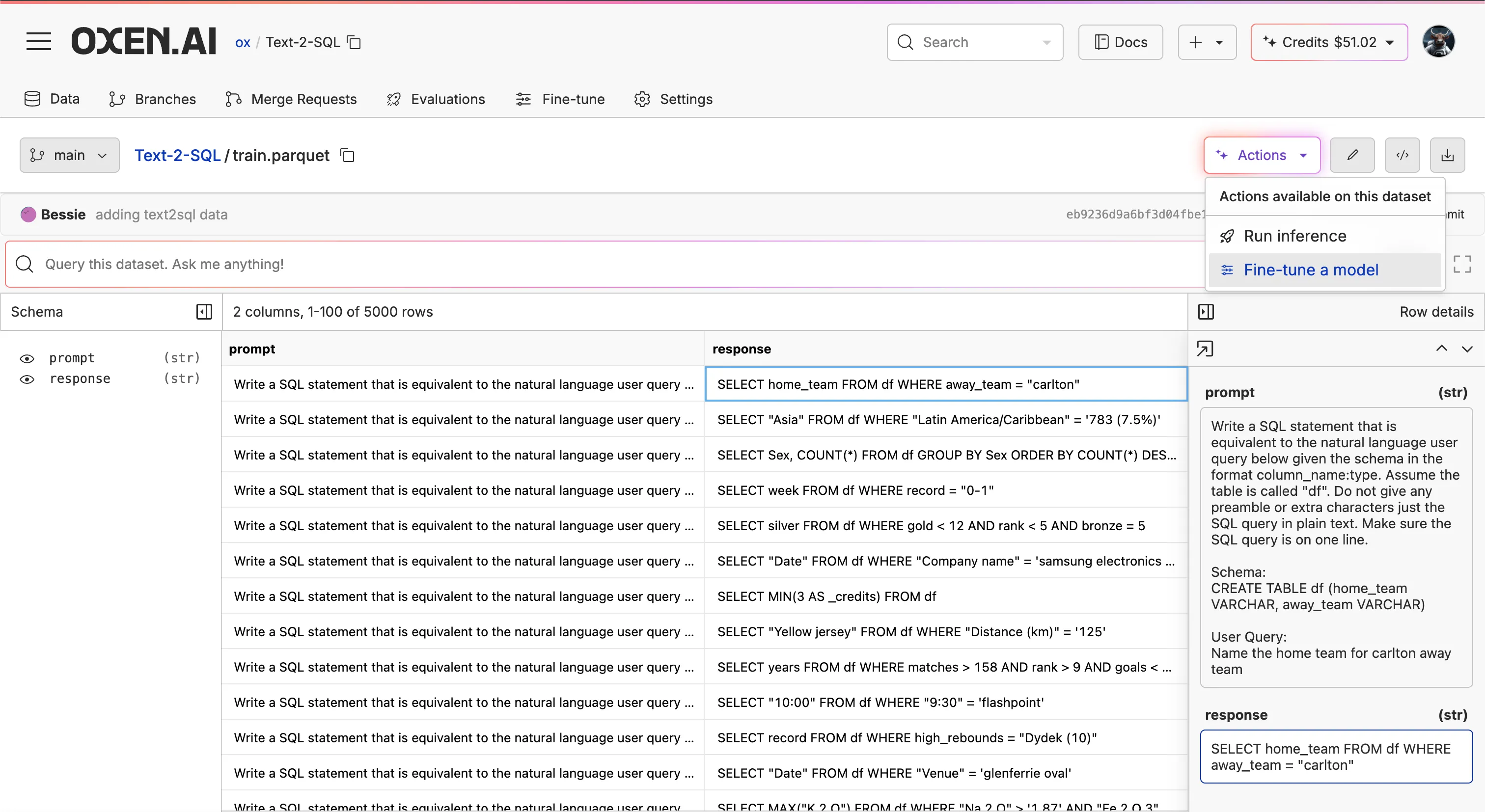
To build successful AI solutions, developers must be able to manage multiple versions of datasets, fine-tuned models and evaluation results. But it can be difficult to track this many experiments and share the assets needed to build large language models (LLMs) across a team.With Oxen.ai, developers can quickly curate datasets and manage fine-tuning workflows in one place. With the company’s open-source version control solution for large datasets and model weights, developers can always identify which data were used to train each version of their model, making it easier to prove performance and pinpoint which techniques worked best. Oxen.ai can support data repositories up to terabyte scale, which is not possible on other solutions.Accelerate the fine-tuning iteration cycle
Fine-tuning a model is rarely a one-time activity. Developer teams often iterate on their models dozens of times, changing the datasets and hyperparameters to improve accuracy and performance. The longer this process takes, the more time and money it consumes.Oxen.ai wanted to speed up this iteration cycle by giving users more control over their datasets and model weights. With access to the raw model weights and versions, developers can more easily customize LLMs for specific tasks, increase accuracy and efficiency or teach models to respond a certain way.
More control with open-source Llama
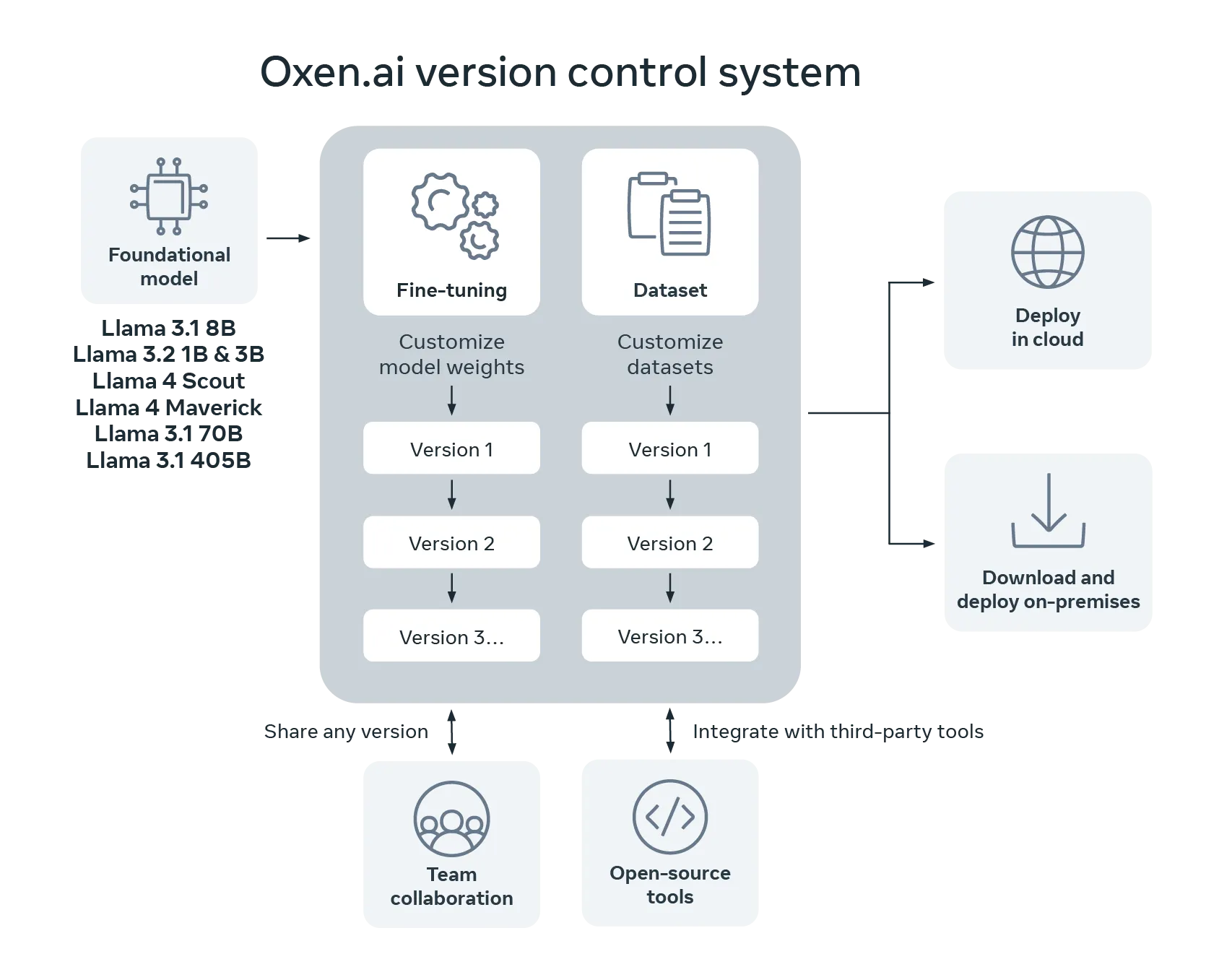
To give developers the greatest ability to customize model weights from end to end, Oxen.ai chose to support a range of Llama models — including Llama 3.1 8B, Llama 3.2 1B and 3B and Llama 4 Scout.With Llama, developers can fine-tune their own models and run inference on proprietary and sensitive data with excellent results. This solution is popular for use cases like document analysis and summarization in highly regulated industries where data privacy is paramount, such as healthcare, legal services and finance. Oxen.ai has seen users switch to Llama from OpenAI, Gemini or Anthropic because of privacy, speed, cost and accuracy needs.
Easier version control and integration
Oxen.ai serves as a central integration point for developers to fine-tune, evaluate and serve models with tools such as Baseten, Fireworks, Lambda Labs, Together.ai and other cloud infrastructure. Users can version Llama weights in Oxen.ai’s open-source version control store, kick off fine-tuning jobs, save the results and compare performance over time. They can also fine-tune or deploy models without having to set up a cluster of GPUs or transfer model weights. For on-premises deployments, users can download their model weights from Oxen.ai and run them anywhere.Storing data and model weights in a centralized repository helps developers integrate with the latest third-party tools while maintaining ownership of their data. Developers can easily use tools from the open-source ecosystem, including Hugging Face transformers, transformer reinforcement learning (TRL), vLLM and SGLang.
Optimizing for accuracy, cost and speed
Today, Oxen.ai considers Llama to be an important part of its strategy in bringing open-source tooling to anyone who wants to build AI solutions. The company is testing Llama as one of the frameworks for an open-source code completion model designed to boost productivity for data scientists and engineers. Oxen.ai will continue to help developers use Llama to optimize for accuracy, cost and speed.- Faster time to value with accelerated processes for fine-tuning and evaluating models
- Greater ability to customize for specific use cases with more control over model weights