Overview
The Text2SQL use case with Llama 3 involves the following components:
- Llama 3 model: The core component of the Text2SQL use case is the Llama 3 model, which converts natural language queries into SQL statements.
- Database: The database contains the structured data that users want to query.
- LangChain: LangChain is a framework that provides a simple interface to interact with the Llama 3 model.
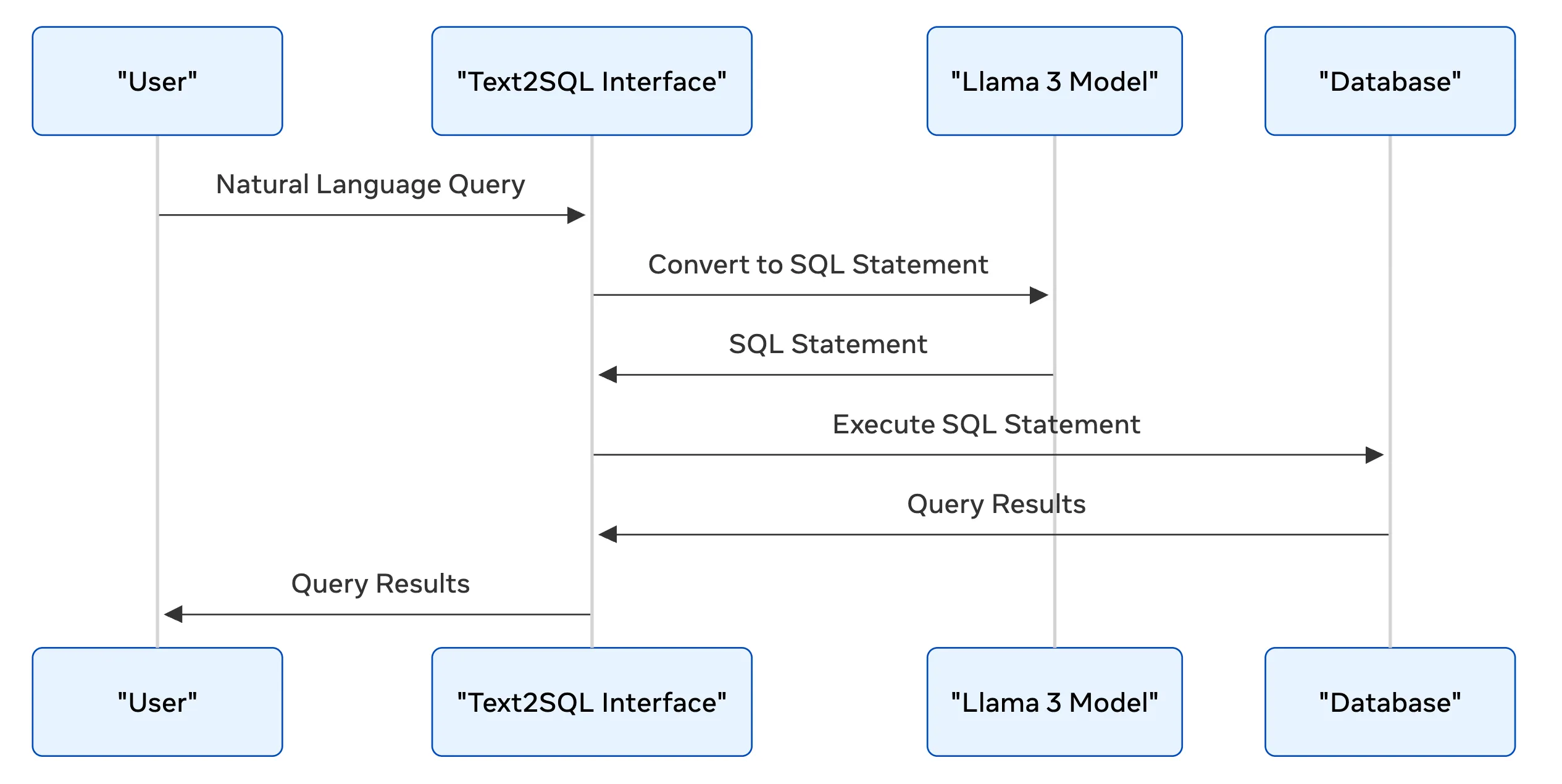
The architecture of the Text2SQL use case can be represented using the following Mermaid diagram:

Implementation Details
Step 1: Set up the environment
Set up the environment by installing the required libraries and frameworks. This includes installing LangChain and the Llama 3 model.
Step 2: Create a database
Identify a database that contains the structured data. For this example, we will use a SQLite database containing NBA roster information.
Step 3: Implement the Text2SQL interface
The Text2SQL interface is implemented using LangChain, which provides a simple interface to interact with the Llama 3 model. The interface takes a natural language query as input and returns an SQL statement.
Step 4: Execute the SQL statement
The SQL statement generated by the Llama 3 model is then executed against the database to retrieve the query results.
The technical implementation can be represented using the following Mermaid sequence diagram: